The story of mass incarceration in Illinois is a familiar one. Our state’s experience has mirrored the national trend of skyrocketing incarceration rates which took flight in the 1970’s and peaked fewer than 10 years ago, driven by punitive policies enacted in legislatures and fueled by “tough on crime” political rhetoric.

Although these harsh penalties often were presented as appropriate punishment for those who threaten our neighborhood’s safety and security, the reality is that they simply created overly-long sentences even for non-violent offenses. As an example, a person who steals items from a neighbor’s unoccupied garage faces a mandatory prison sentence of 4-15 years in Illinois. Even if it is a first offense, probation is not an option. And a judge passing this sentence is not able to consider any other factors, including what circumstances might have led to the criminal activity.

So, like other states, Illinois has seen an explosion in those behind bars. In 1980, Illinois’ prison population was 11,768. Today, it stands at more than 30,000, after reaching a historic peak of nearly 50,000 in 2013.Across the country, the United States incarcerates its own people at a much higher rate than any other country in the world: more than 2 million people are incarcerated nationwide, most of them in State prisons and local jails.

The biggest drivers of Illinois’ prison population have been sentencing policies that significantly increased the length of prison sentences: the unsuccessful War on Drugs, mandatory minimums, three strikes, and truth in sentencing. While the ostensible reason for these changes was to reduce crime, in fact overall rates of violent and property crime have been declining for decades even as more punitive sentencing policies took hold.

The reality is that increasing the severity of sentences does little to deter or reduce crime, but the overuse of incarceration has actually harmed public safety in communities where its impact is concentrated, especially within communities of color. These harmful policies drain these communities of economic resources, break up families, and contribute to social conditions that produce intergenerational cycles of over-policing, trauma, and incarceration.

Illinois’ Black and Latinx communities have borne the brunt of these misguided laws. While Black Illinoisans make up 14.5% of the State’s population, the prison population is 54.8% Black. Black people are imprisoned at 8.8 times the rate of whites—one of the worst disparities of any state. And the COVID-19 pandemic has revealed that our overuse of prisons and jails also jeopardizes public health and deepens existing social inequities.

Along the path to our current predicament, there have been moments of self-reflection by Illinois policymakers. When the state’s incarcerated population was exploding, there were no fewer than four different task forces and commissions tasked with recommending reforms to address failures in our criminal legal system. As recently as 2015, a bipartisan Commission was appointed by former Governor Rauner to formulate policies that would reduce Illinois’ prison population and create a less punitive and more rehabilitative criminal legal system.

Like the expert panels that preceded it, the Commission’s work led to policy recommendations which - had they actually been implemented - would have resulted in more families staying together, fewer people returning to communities with criminal histories weighing them down, and more investment in communities. But, like the plans put forth under prior Governors, few of the Commission’s recommendations were ever implemented.

Today, there are still far too many people in Illinois prisons who could be safely released, and many who never should have been sent there in the first place. The Illinois Department of Corrections budget alone is $1.5 billion a year, far too much for people in our state to support an unjust system that produces little public safety benefit.    

ACLU polling shows that most Illinois voters support lawmakers committed to reducing incarceration, and support taking significant steps to reform sentencing in Illinois’ criminal legal system. These findings belie the widely held view that the public would be opposed to such changes in sentencing for fear of a political attack labeling an officeholder as “soft on crime.”

In this moment, we have a unique opportunity. The Illinois prison population is at its lowest level in 20 years as a result of declining arrests for drug and property crime, as well as temporary holds on transfers from county jails to state prisons during the pandemic. After decades of making policy based on anecdotes and political mailers, lawmakers have finally begun to demand and rely upon data around our use of prisons and jails. At the same time, people across the country are finally awakening to the ugly reality that racism is deeply ingrained in many of our institutions, especially in policing and the criminal legal system, and demanding change.

Governor Pritzker recently unveiled seven “principles to build a more equitable criminal justice system,” including modernizing sentencing laws for drug and property crimes and reducing the length of excessive prison stays. “[W]e spend billions of dollars a year keeping too many people in an overcrowded prison system that has proven itself too expensive, too punitive and wholly ineffective at keeping Illinois families safe,” said the Governor. “As we move forward with the General Assembly to pass comprehensive criminal justice reform, it is my hope that the nation will look to Illinois as a leader in true equity and justice for generations to come."

Illinois must not turn back. The time has come for real sentencing reform, and we must commit to these four essential elements to have real impact:

  • Reducing minimum sentences and eliminating mandatory minimums.
  • Reclassifying minor drug and property offenses.
  • Reducing the length of commitments to the Department of Corrections.
  • Applying reforms retroactively to currently incarcerated people.
Date

Wednesday, October 21, 2020 - 12:45pm

Show featured image

Hide banner image

Tweet Text

[node:title]

Related issues

Criminal Justice Reform

Show related content

Menu parent dynamic listing

28

Show PDF in viewer on page

Style

Standard with sidebar

The below statement can be attributed to Rachel Murphy, Police Practices Project Staff Attorney, ACLU of Illinois: 

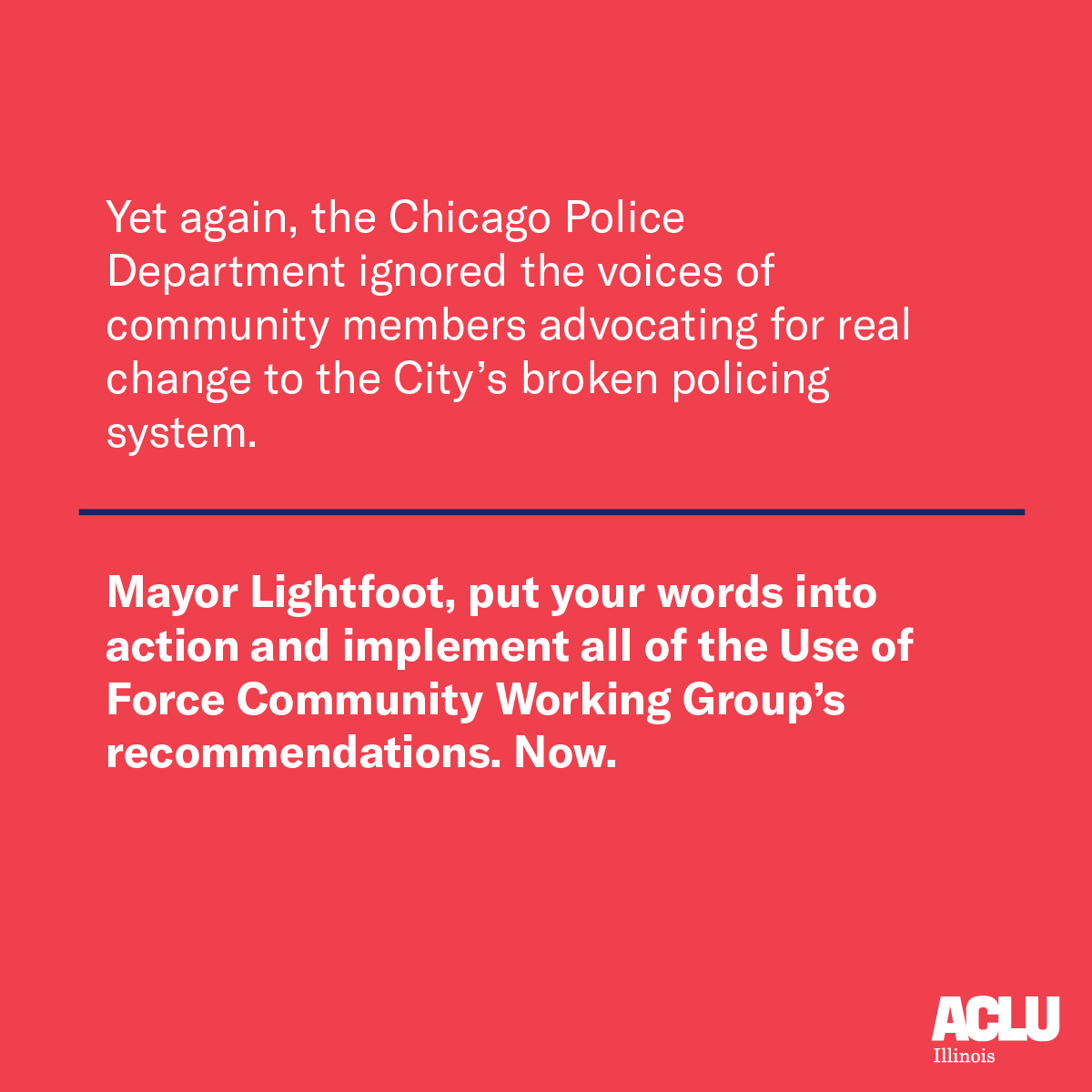
"It is unacceptable that, yet again, the Chicago Police Department ignored the voice of community members in the process of bringing real change to the City’s broken policing system. Excessive use of force by police has killed and harmed people across the City and cost millions of dollars to taxpayers over many years. After years of abuse, CPD cannot be trusted to fix this policy on its own.

As Mayor Lightfoot and Superintendent Brown both stated, the purpose of the Use of Force Community Working Group was to bring community members to the table to partner with CPD in revising and improving use of force policies. We were proud to serve with many members from neighborhoods and organizations across Chicago, whose range of lived experience and professional expertise resulted in a comprehensive set of recommendations to dramatically reform when and how CPD officers can use force.  

But instead of drawing on the Working Group’s knowledge and perspectives to reflect the way forward, CPD ignored and dismissed the input of the group. CPD adopted a few symbolic changes to language, but rejected dozens of substantive recommendations related to de-escalating incidents, limiting the situations in which force can be used, respecting the dignity of those harmed by the police, and improving reporting and investigation processes. 

The Mayor and the Superintendent made clear when the Working Group was established that they welcomed input. Not even hearing that input further destroys public trust and sets back police reform in our city."  
 

Date

Friday, October 16, 2020 - 6:15am

Featured image

codreform

Show featured image

Hide banner image

Tweet Text

[node:title]

Related issues

Police Practices and Racial Justice

Show related content

Menu parent dynamic listing

28

Show PDF in viewer on page

Style

Standard with sidebar

Sandra Botello, an unemployed mother living in Chicago, faced a difficult financial choice – pay $400 in school fees for her son or cover the cost of renewing Chicago’s mandatory vehicle sticker. She paid the school fees, keeping her son’s education moving forward – but within weeks received five $200 tickets for not having a vehicle sticker. Late fees and collection fees caused her debt to balloon to nearly $3000. Chicago impounded Ms. Botello’s car for unpaid tickets, charged additional fees for storing her car for 33 days, ultimately sold the car for scrap, and left her with thousands of dollars of debt. 

Today, the U.S. Supreme Court hears arguments in Chicago v. Fulton, a case with profound implications for Ms. Botello and millions of others across the country who are buried under mountains of debt from fines and fees they cannot afford to pay to state and local governments. As our country grapples with an economic recession that has plunged millions of people into financial crisis—with Black and brown communities hardest hit—the Supreme Court’s ruling on the bankruptcy question raised in Fulton is of critical importance nationwide. 

Fulton concerns three bankruptcy cases resulting from Chicago’s draconian practice of addressing staggering budget gaps by squeezing people for money through hefty fines and fees, driver’s license suspension, and the seizure of their cars. Chicago seized the cars of Timothy Shannon and George Peake for unpaid tickets and the car of Robbin Fulton for driving on a license suspended for unpaid tickets. It also charged them thousands of dollars in fees to get their cars back. Unable to pay, each debtor sought a fresh start by filing for Chapter 13 bankruptcy. 

Instead of returning the cars to Fulton, Shannon, and Peake when they each filed for bankruptcy, Chicago kept the cars, making it hard for them to go to work, earn money, and care for their families. Their cases raise the question of whether a creditor violates the automatic stay and turnover provisions of the Bankruptcy Code when it decides, after a debtor has filed for bankruptcy, not to return estate property to the debtor. The bankruptcy courts and the Seventh Circuit Court of Appeals all ruled that Chicago violated the law. Chicago sought review in the Supreme Court.

Last March, the ACLU and groups across the ideological spectrum—the Cato Institute, Fines and Fees Justice Center, Institute for Justice, Rutherford Institute, and R Street Institute—submitted a friend-of-the-court brief to the Supreme Court in Fulton. We argue that Chicago’s practice of keeping cars violates both the plain text of the Bankruptcy Code and Congress’ intent in establishing bankruptcy to give people a fresh start.

Our brief explains that the Bankruptcy Code requires creditors to return estate property to debtors immediately after the filing of a bankruptcy petition because debtors often need that property—like their cars—to earn income and make the payments required for a Chapter 13 bankruptcy plan. Instead of playing by the rules, Chicago seeks to keep cars locked up to coerce debtors into paying Chicago first. This practice causes real harm.

For example, Fulton needed her car to get to her job, take her pre-school age daughter to day care, and care for her elderly parents. Shannon, a housekeeper, needed his car to get to work. Peake needed his car for his daily 45-mile commute. None of this is surprising since 86% of Americans describe a car as a necessity of life and 70% of Chicago commuters drive alone to work.

Our brief also provides context critical to understanding the national importance of the Supreme Court’s ruling in Fulton. Chicago’s ticketing and impoundment practices are part of a nationwide trend in which governments turn to fines, fees, and punitive collection practices—instead of taxes—to raise public revenue. Cities and towns across the country use ticketing to raise money, leading to what some call “taxation by citation.” Nearly 600 cities raise at least 10% of their general fund revenue through fines and fees, and at least 284 rely on fines and fees for 20% or more of their general funds. 

These powerful incentives for governments to impose fines and fees people cannot afford lead to crushing debts. Fines that are manageable for a person of means may be out of reach for a poor or low-income person. As of April 2020, 37% of American adults surveyed by the Federal Reserve reported facing difficulty covering a $400 emergency expense. Those who cannot immediately pay often face draconian collection efforts—like the suspension of their driver’s licenses (a problem in 41 states and the District of Columbia, including Illinois) and vehicle impoundment—leading to more fines and fees.

As of 2018, people owed a staggering $1.45 billion to Chicago in unpaid tickets dating back to 1990. These ruinous debts have propelled tens of thousands of people to seek bankruptcy relief, causing the U.S. District Court for the Northern District of Illinois to lead the nation in non-business Chapter 13 bankruptcy filings. Chicago, California, Texas, Pennsylvania, and Denver all use vehicle impoundment to collect certain fines and fees. 

The COVID-19 pandemic has made matters worse. State and local budget deficits have skyrocketed due to the recent economic downturn, increasing pressure on governments to balance budgets through fines, fees, and punitive collection tactics. Chicago’s aggressive ticketing and impoundment practices initially sought to address a 2011 budget deficit of $650 million, which was itself the result of the last recession. Now, Chicago confronts a 2021 budget deficit that may be as high as $1.6 billion

Millions of people nationwide are out of work and facing rent, utility, and other costs they cannot afford, with Black and brown communities hit hardest. A summer 2020 poll of residents in Houston, Los Angeles, New York and Chicago revealed dramatic racial and ethnic disparities in pandemic-related financial distress. While 50% of Chicago households reported serious financial problems since the start of the COVID-19 pandemic, 69% of Black households and 63% of Latinx households reported the same. 

The increasingly common practice of imposing fines and fees to generate government revenue and of impounding vehicles as a collection tactic falls heavily on the poorest among us – especially people of color. In resolving Fulton, the Supreme Court must recognize that the Bankruptcy Code was designed to give those who fall into serious debt a chance to begin anew—and that Chicago is violating both the letter and purpose of the law.  

Date

Tuesday, October 13, 2020 - 6:00am

Show featured image

Hide banner image

Tweet Text

[node:title]

Related issues

Criminal Justice Reform

Show related content

Menu parent dynamic listing

28

Show PDF in viewer on page

Style

Standard with sidebar

Pages

Subscribe to ACLU of Illinois RSS