The following statement can be attributed to Khadine Bennett, Advocacy and Intergovernmental Affairs Director of the American Civil Liberties Union of Illinois:

“Reforming criminal justice and demanding meaningful police accountability are critical priorities for communities and people that are most harmed by the broken policing and criminal legal systems. In Illinois, like in many other states, those most harmed are Black and Brown people. 

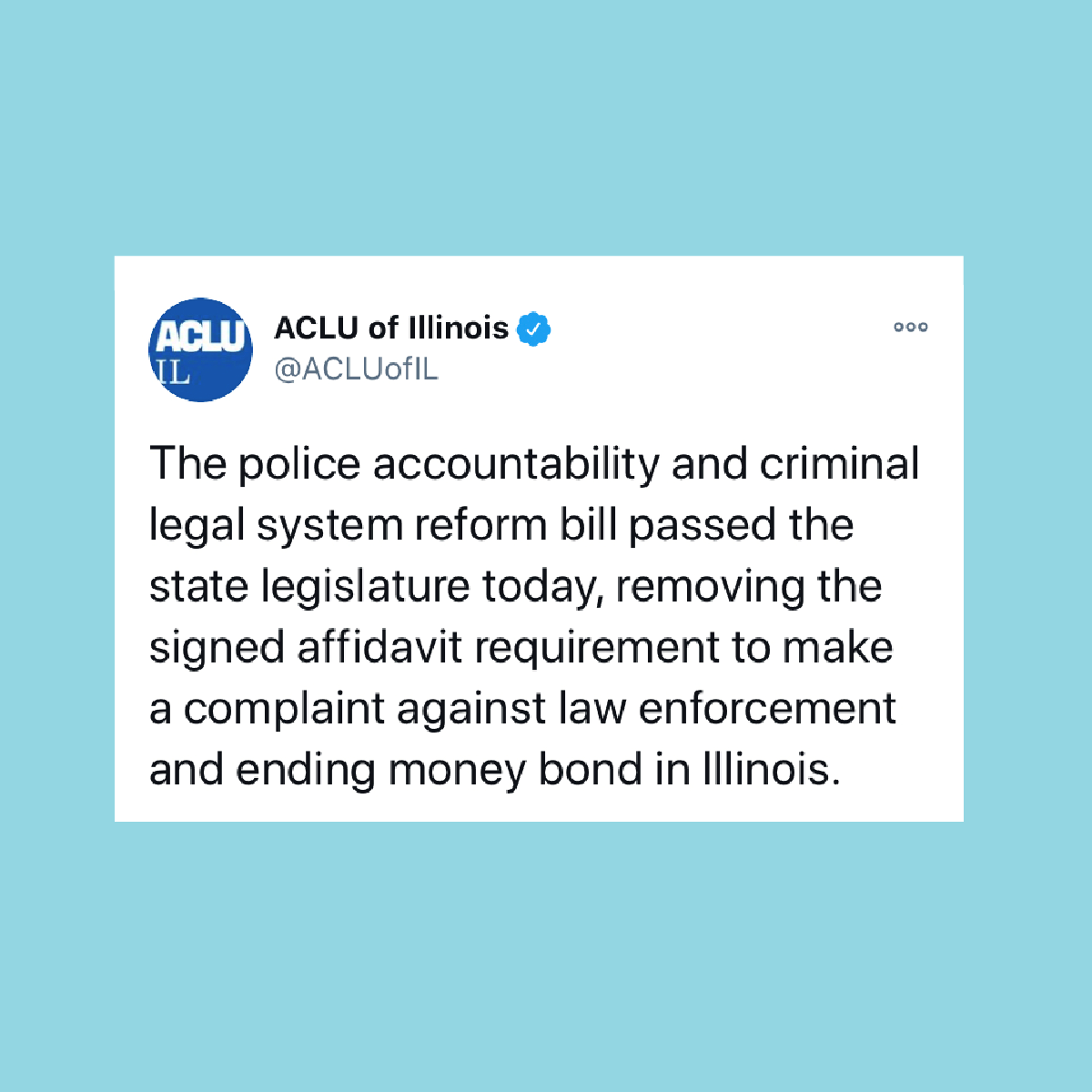
Today, the Black Caucus’ Justice Pillar, House Bill 3653, sponsored by Senator Elgie Sims and Representative Justin Slaughter, was approved by the Illinois House and Senate chambers, and is prepared for the Governor’s signature. 

Our system of policing does not demand the appropriate level of accountability – resulting in mistreatment of too many. Massive, national protests pointed out this harm throughout 2020. Likewise, our criminal legal system relies too much on incarceration and punishment and does not provide appropriate opportunity for diversion and rehabilitation.

While there is still work to do, the end of the last seven days of lame duck session has put us on a path that can lead to meaningful change.

The bill includes components of police accountability and criminal legal system reform policy changes that advocates, including the ACLU of Illinois, have been working to move forward for years, and pushing non-stop since the summer. Among other important ACLU priorities, the bill removes an antiquated and unnecessary requirement that those making complaints against police sign a sworn statement. And, the bill addresses the real harm of our bail system which keeps people detained simply because of their economic status.  

We applaud Senator Sims, Representative Slaughter and the entire legislative Black Caucus for their leadership in this area and their commitment to these issues. They embraced the need for change and were committed to moving this legislation through the General Assembly. 

We are excited about the changes made today and look forward to continuing to partner with legislators to continue our work to create a policing and criminal legal system that ensures accountability and reflects a commitment to rehabilitation and restoration over penalties. That work will go on after today.”  

Date

Wednesday, January 13, 2021 - 12:00pm

Featured image

policingbill

Show featured image

Hide banner image

Tweet Text

[node:title]

Related issues

Police Practices and Racial Justice Criminal Justice Reform

Show related content

Show PDF in viewer on page

Style

Standard with sidebar

As legislators prepare to consider much-needed legislation to reform policing in Illinois, new polling released today shows that 9 out of 10 (91%) Illinois voters are strongly supportive of legislative efforts that hold police accountable for misconduct. 69% of voters agree that reform is necessary now because of racial bias in policing.

The polling results address a number of proposals contained in what is hoped to be major policing legislation in Illinois. The Legislative Black Caucus released language for a police reform bill that aims to be transformative – House Bill 163 (Senate Amendment #2) – as part of a broader pillar aimed at justice reform.

The polling shows broad voter support for many provisions included in the bill and show that voters are supportive of holistic reform. 

Among other findings, the poll finds that nearly 9 out of 10 voters back:

  • Holding law enforcement accountable for violating individuals’ constitutional rights (89% say it should be a major priority)
  • Establishing clear and consistent statewide limits surround the use of force by police, including deadly force (80% say it should be a major priority)
  • Training all police to a clear and consistent standard surrounding the use of force by police, including deadly force (90% say it should be a major priority)
  • Rules mandating that officers are held responsible when they use force without justification resulting in a death (88% support)
  • Establishing consequences for not turning on dashboard or body cameras (88% support)

In addition, more than 3 out of 4 voters in Illinois support banning chokeholds (76%) and requiring a state agency to report when a police officer uses force (78%), while an overwhelming 69% of voters want to end special protections for police officers – known as qualified immunity – that allows officers to escape from many lawsuits, denying victims of real harm a day in court.  And nearly two-thirds of voters (66%) support an end of so-called “no-knock” warrants. The warrant process in the state has been under even more scrutiny since public disclosure of body cam video of Chicago social worker Anjanette Young being held handcuffed and naked in her own home during a botched raid. 

Finally, a majority (56%) of voters support ending the antiquated and chilling requirement that someone making a complaint against a police officer must sign a sworn affidavit, opening themselves up to prosecution simply to lodge a complaint against a police officer. 

In response to the release of the overwhelming demonstration of public support for reform by voters in Illinois, Khadine Bennett, Director of Advocacy and Intergovernmental Affairs at the ACLU of Illinois, which commissioned and released the poll issued the following statement:

“We have seen enough videos, we have heard enough stories, and we have represented enough people who have been victims of abuse, racial profiling, and intimation by police. We know that Black and Brown people in communities throughout Illinois continue to be disproportionately targeted and harmed.

The time for nibbling at the edges is over.

The bill to be considered in Springfield must meet the demands of the people in Illinois who protested and demonstrated after the killing of George Floyd. It has to address use of force that results in death and abuse at the hands of police, and the lack of accountability when police misconduct occurs.

Legislation that holds police accountable when they abuse their power or violate constitutional rights; creates a statewide use of force standard that gives law enforcement and citizens clear guidance for if and when force can be used; restricts the use of military equipment and tactics; removes barriers to anonymous complaints; and requires transparent data collection that measures successful implementation shouldn’t be controversial, it should be expected.

The poll shows that narratives around political backlash to police reform are overblown: just 9% of voters say they would be less likely to support a legislator that increases police accountability, as compared to two-thirds of voters (66%) who said they were more likely to support a legislator who voted for measures that increase police accountability in Illinois. It is time to act. 

Legislators must push back against those who would resist or water down any reform to policing in Illinois. The protests and demonstrations of 2020 make clear, and the polling reinforces, that Illinois voters are ready for change.”

The polling information released today is drawn from two separate polls of 600 voters in Illinois. The first poll was conducted by Global Strategy Group from October 27-November 4. The second poll, also conducted by Global Strategy Group, took place from December 15-21, 2020.  Both surveys have a margin of error of +/- 4.0% and were conducted online using a voter file match. Care was taken to ensure each poll represented the registered voter universe.  

Date

Friday, January 8, 2021 - 12:45pm

Show featured image

Hide banner image

Tweet Text

[node:title]

Related issues

Police Practices and Racial Justice Criminal Justice Reform

Show related content

Menu parent dynamic listing

28

Show PDF in viewer on page

Style

Standard with sidebar

Teaser subhead

As legislators prepare to consider much-needed legislation to reform policing in Illinois, new polling released today shows that 9 out of 10 (91%) Illinois voters are strongly supportive of legislative efforts that hold police accountable for misconduct.

Since the 1970’s, the steep increase in Illinois’ incarcerated population has been driven primarily not by any rise in crime, but by the drastic escalation in the length of sentences imposed by elected officials. As a result, more people spend more of their lives incarcerated than at any point in our state’s history.

Today’s excessively long prison stays are the result of punitive sentencing laws enacted over the past several decades in Springfield. Year after year, Illinois’ huge investments in the prison system - more than $1.5 billion annually - are misspent warehousing people in harmful conditions for needlessly long periods of time. At the same time, tens of thousands of Illinois residents are required by law to live under surveillance by corrections agents for years after their release, resulting in far too many people being sent back to prison.

Perhaps no single policy has caused the length of prison stays to balloon more than so-called “truth in sentencing” laws, which place arbitrary restrictions on people’s ability to earn time off their sentences. Previously, people sentenced to prison in Illinois could earn sentence credit for good behavior and participation in programs. Most people were even eligible to reduce their sentence by as much as 50%, which allowed them to return to their families or back to work quicker.

But in 1998, the Illinois General Assembly passed a law that severely restricted the amount of sentence credit that people convicted of certain crimes were allowed to earn and prohibited people convicted of murder from receiving any sentence credit at all. At the time, many legislators believed that judges would counterbalance the new laws by adjusting sentences downward, and therefore, the length of prison stays would not increase dramatically.

That simply did not happen. In fact, there was only a small decline in the sentences imposed by courts, which was far outstripped by the new law’s requirement that people serve a much greater percentage of their sentence. The net effect of truth in sentencing in Illinois was to keep people in prison far longer for the same crimes.

Illinois’ move toward so-called “truth in sentencing” and similar laws was grounded in a mistaken belief that locking up people for longer periods of time would make communities safer. But research has shown that idea to be incorrect. Increased incarceration has a marginal and diminishing effect on decreasing community crime, but instead comes at a heavier social and economic cost that can even cause crime to increase.

Overly long sentences isolate individuals from their families and leave them unprepared to successfully re-integrate into their communities. Beyond the harm to incarcerated people themselves, long-term imprisonment shatters families and forces children to grow up without parents, grandparents, caregivers, and more. These punishing policies overwhelmingly impact families who live in segregated, low-income urban neighborhoods already reeling from decades of disinvestment, and exacerbate the social problems that lead people to commit crimes in the first place.

To decrease these kinds of assaults on low-income and communities of color in Illinois, legislators in our state must roll back “truth in sentencing” laws to reduce the excessive length of prison stays, while also incentivizing incarcerated people to follow rules and take advantage of prison programs that can help prepare them for successful reentry. This includes:

  • People currently required to serve 75% of the sentence imposed should be eligible to reduce length of stay to 50% - the same as incarcerated people not subject to truth in sentencing laws.
  • Those mandated by law to serve at least 85% of their sentences should be eligible to reduce the time served to around 72% of the sentence.
  • People convicted of murder--currently required to serve 100% of the prison sentence imposed by the court--should be eligible to earn sentence credit resulting in a length of stay of 75% of the sentence.

Illinois must also reduce the length of post-release supervision which, according to a 2019 John Howard Association report,“does not appear to measurably improve public safety, either by preventing or detecting crime through surveillance or by providing rehabilitative support to people leaving prison to assist in reentry and reduce recidivism.”

Currently, everyone released from prison must remain under supervision by the Department of Corrections for a lengthy period of “mandatory supervised release” (MSR) before their sentence will be fully discharged. The length of supervision is determined according to the crime for which the individual was incarcerated—not an individualized assessment of whether the person actually needs to be supervised.

While on MSR, a person must comply with a long list of conditions, which may include allowing parole agents to inspect and search their residence whenever they want, abstaining from alcohol and drugs, and avoiding contact with certain people or places. A person on this kind of supervision may even be ordered to wear an electronic monitoring shackle that effectively incarcerates them in their own home, despite evidence that electronic surveillance has “minimal effect on reducing recidivism and changing criminal behavior.”

If a person is found to have violated any condition of their release, they may be summarily returned to prison on a “technical violation.” In 2019 alone, over 9,000 individuals on MSR—57% of whom were Black — were sent back to prison on technical violations. Illinois would benefit from:

  • Shortening the period of MSR to 18 months for people released from prison for higher-level offenses (Class X, 1 and 2 felonies).
  • Eliminating this supervision for people released from prison for most lower-level crimes (Class 3 and 4 felonies), unless the Prisoner Review Board specifically determines, based on a validated risk and needs assessment tool, that it is necessary for the person to serve an MSR term.
  • Limiting this supervision to 1 year for individuals who were convicted of Class 3 felonies, and 6 months for those convicted of Class 4 felonies.

Illinois needs to stop using expensive and ineffective surveillance tools that set people up to fail. It is time to give up the false promises of “truth in sentencing” laws, and focus instead on meeting the housing, education, and employment needs of formerly incarcerated people and their communities.
Date

Thursday, December 17, 2020 - 12:15pm

Show featured image

Hide banner image

Tweet Text

[node:title]

Related issues

Criminal Justice Reform

Show related content

Show PDF in viewer on page

Style

Standard with sidebar

Pages

Subscribe to ACLU of Illinois RSS