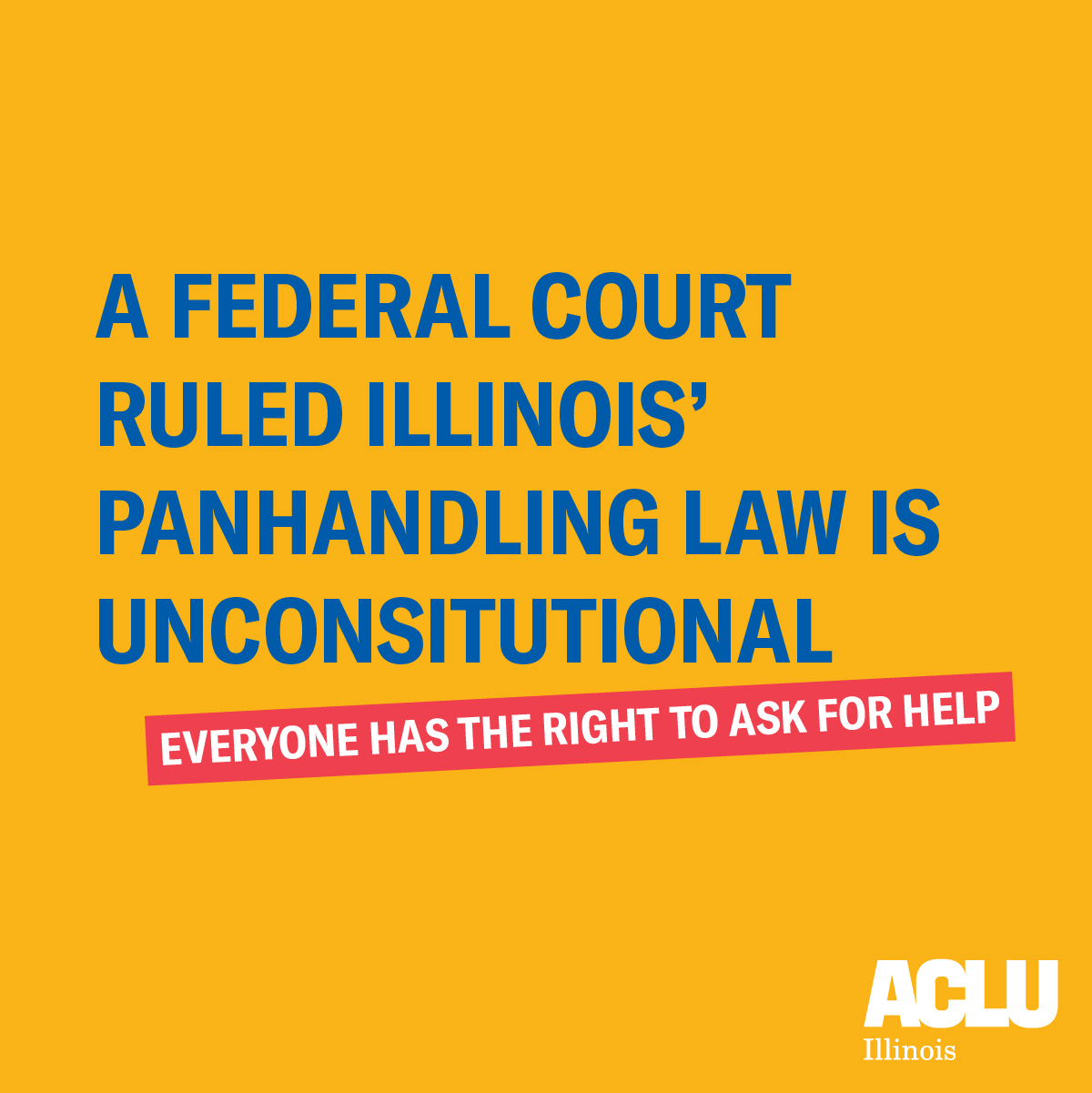
A federal district court judge in Chicago last week struck down a state law prohibiting panhandling in public streets and medians and ordered Illinois State Police not to enforce it. The ruling ends a lawsuit by two men experiencing homelessness who challenged the law. Michael Dumiak and Christopher Simmons sued after they were repeatedly ticketed and fined for asking passing motorists for help at a suburban Chicago intersection, while charities and religious groups collected donations at the same location without consequence. 
 
The judge’s ruling resolves the case against the Illinois State Police and the DuPage County State’s Attorney challenging the constitutionality of the statute.  Other defendants – the Village of Downers Grove and several of its police officers – recently settled the claims against them and paid damages to Mr. Dumiak and Mr. Simmons after the Village repealed an ordinance similar to the state law.      
 
Mr. Dumiak is pleased with the ruling, saying “Some of us are just out here because we need help, especially during this hard time with COVID-19. I can’t find a job right now.”  
 
Christopher Simmons, the other plaintiff, passed away late last year.  He survived long enough to receive his monetary settlement from the Village of Downers Grove, but not to see the final resolution of the case. Upon receiving the settlement, Mr. Simmons stated, “This feels so great not just for me but for all people who are homeless,” said Christopher Simmons. “This began simply because I needed to ask for help. I’m thankful the federal court recognized I have a right to do that.”  
 
“As the court recognized, government may not punish speech requesting personal donations while allowing other speech at the same time and place,” added Rebecca Glenberg, senior staff attorney at the ACLU of Illinois. “Unfortunately, many local governments in Illinois still have anti-panhandling ordinances. Those municipalities are now on notice that they must repeal those laws or risk liability in federal court.” 
 
“For years our homeless clients have faced criminal penalties for exercising their First Amendment rights,” said Diane O’Connell, Community Lawyer at the Chicago Coalition for the Homeless. “This decision is one in a line of cases that is finally changing these terrible laws across the United States.  No one should face arrest because they ask for help.”  
 
Mr. Dumiak and Mr. Simmons were charged under an Illinois statute that makes it a misdemeanor to stand on a median to solicit contributions, employment, business, or rides from passing vehicles. The statute does not prohibit other interactions with drivers and passengers, such as gathering petition signatures or distributing leaflets. It allows municipalities to exempt certain charities from the law, even as local police enforce it against individuals who ask for money for their own use.  
 
A 2015 U.S. Supreme Court ruling made it clear that most laws targeting panhandlers are unconstitutional. Although the case (Reed v. Town of Gilbert) was not about panhandling, the Supreme Court clarified that government regulation of speech based on its subject matter or purpose is almost always unconstitutional. Since Reed was decided, panhandling ordinances across the nation have been repealed or struck down by courts.  
 
Mr. Dumiak and Mr. Simmons were represented by lawyers for the ACLU of Illinois, the Chicago Coalition for the Homeless (CCH), and the Chicago office of Schiff Hardin. 

Date

Tuesday, January 19, 2021 - 6:00am

Featured image

federalforces

Show featured image

Hide banner image

Tweet Text

[node:title]

Related issues

First Amendment Advocacy

Documents

Show related content

Menu parent dynamic listing

28

Show PDF in viewer on page

Style

Standard with sidebar

As distribution of the vaccine for the coronavirus moves into the next phase, the Pritzker Administration is planning to prioritize prisoners in Illinois Department of Corrections’ facilities for vaccination. The decision recognizes the heightened risk faced by those who are incarcerated in places where they cannot ensure social-distancing or consistent use of personal protective equipment, as well as the associated risk to local public health resources.  

In response to this decision, Camille Bennett, Director of the Corrections Reform Project at the ACLU of Illinois, issued the following statement: 

“COVID-19 has ruthlessly demonstrated that all of us can be infected, especially those without the ability to engage in routine practices like social distancing and regular hygiene. Prisons and detention centers have been vectors and accelerants of spread. Nearly 10,000 Illinois prisoners have contracted the virus. More than 70 have died. 

For this reason, it makes sense for Illinois to prioritize the people detained in these facilities for vaccination as a small part of the next phase of vaccine rollout. This will promote the safety of staff and residents of these facilities and surrounding communities who rely on the same public health resources. 

We urge everyone to ignore the temptation of political attacks on this decision. The suggestion that someone should die from COVID complications simply because they are incarcerated fails to recognize the value of human life. Vaccinating prisoners will save lives in the facilities and in the communities surrounding them. This is good policy.” 

Date

Monday, January 18, 2021 - 1:15pm

Show featured image

Hide banner image

Tweet Text

[node:title]

Related issues

Institutionalized Persons

Show related content

Show PDF in viewer on page

Style

Standard with sidebar

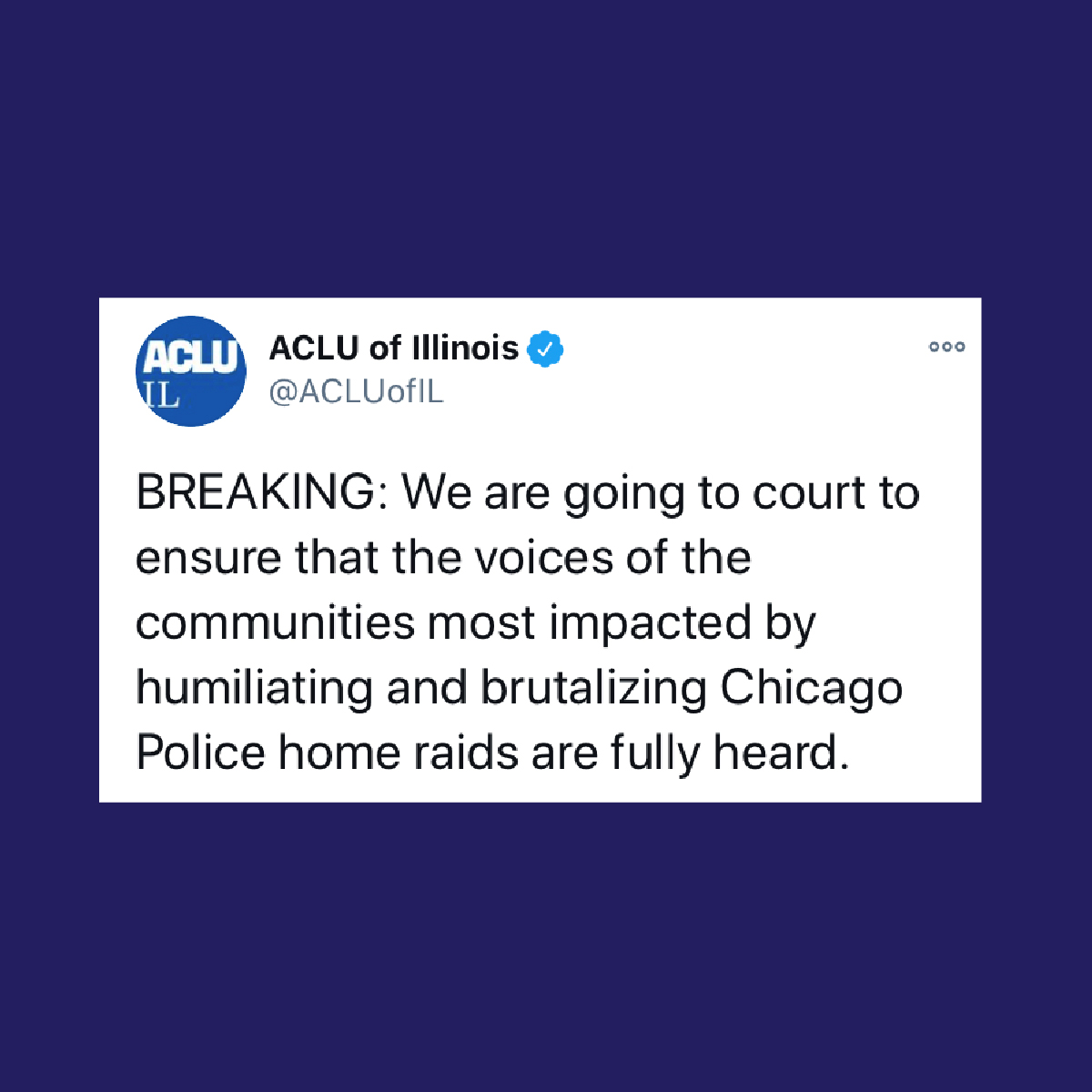
A coalition of community organizations and activists recently asked a federal court to intervene and force the City of Chicago to address the systemic abuse of unlawful warrants and home raids. This request marks the very first time that the court has been asked to enforce the 2019 consent decree meant to guide reform of the City’s police department. The Coalition organizations are: Black Lives Matter Chicago, Communities United, Community Renewal Society, the Chicago Urban League, Blocks Together, Brighton Park Neighborhood Council, Justice for Families—Black Lives Matter Chicago, Network 49, Women’s All Points Bulletin, 411 Movement for Pierre Loury, and Next Steps, ONE Northside, and the West Side Branch of the NAACP, and the ACLU of Illinois.
 
The issue of home raids by CPD officers gathered attention late last year when video emerged of the wrongful raid of Anjanette Young. The shocking video sparked national headlines and local outrage.
 
“CPD’s abhorrent and inhumane treatment of Black women must end with this enforcement motion. The City and CPD must negotiate with us in good faith and implement the comprehensive changes recommended by the Coalition that are needed to end--once and for all - CPD’s violence in the Black community and particularly the violence perpetrated on Black women’s bodies. If they fail to do so, we are prepared to seek punitive sanctions from the Court,” said Crista Noel, CEO and founder of the Women’s All Points Bulletin, WAPB Inc.
 
In an August 2020 letter to the City, the Coalition described numerous home-raid related Consent Decree violations - including a pattern of raids involving excessive force, traumatization, and abuse of women, children and families, and a failure to properly supervise and hold officers accountable. The Coalition requested a meeting with the City, independent monitor, and the Illinois Attorney General. Weeks later, the Illinois Attorney General also urged the City to work with the Coalition on the issues of home raids.  
 
The City refused to respond. Silence has generally been the response to the Coalition’s consistent requests for the city to remedy its numerous failures to comply with the Decree.
 
“The trauma that Chicago police home raids cause is not new,” said Eric Wilkins, an organizer with Communities United. “For my community, home raids are just another predatory police tactic that harasses and degrades us. In Englewood and Roseland, these raids tear apart our homes and our families. This is why the Coalition has gone to court to make the City take this matter seriously and work with directly impacted communities.”
 
According to CPD’s own data, obtained by CBS 2 News, between January 2016 and January 2019, 45% of raids, roughly 3,000, did not result in an arrest. The data also shows that CPD continues to engage in racially-disparate policing. The five neighborhoods with the highest number of wrongful raids are Englewood, Austin, North Lawndale, Garfield Park and Humboldt Park, which are predominantly Black and Latinx.
 
A central concern for the coalition is the devastating impact of these practices on children and families. There is a clear pattern of excessive force and abuse towards families and children, including violently barging into homes, shouting and cursing, and pointing guns at small children. 
 
“The City must show it is serious about addressing degrading home raids that result in unequal justice and lasting trauma by truly engaging with the Black and Brown communities harmed by these abuses,” added Nusrat Choudhury, Legal Director at the ACLU of Illinois. “By ignoring the Coalition’s request to meet, the City has forced us to seek court assistance for a process to address the broken systems leading to this abuse.”  
 
Here, in particular, Chicago continues to fall short of the national standards, such as those established by the International Association of Chiefs of Police (IACP) which lays out specific recommendations for protecting children during adult searches and arrests. Other major cities, such as San Francisco and Indianapolis, have successfully adopted detailed protocols specifically addressing police interactions with children.
 
CPD does not even require officers executing search warrants to investigate whether children either live in the residence or are likely to be present during the raid. CPD does not train officers to either schedule raids when children are least likely to be present or plan raids with the goal of protecting children at the location. CPD search warrant policy implemented in January 2020 does not prohibit any specific conduct, including the pointing of guns at children.
 
CPD’s practice of executing unlawful warrants and raids is facilitated by a lack of accountability for officers.  Despite hundreds of complaints being filed about raids, hardly any result in consequences, and officers who are disciplined receive only minor sanctions. The twelve officers who facilitated the largest number of warrants resulting in negative raids amassed 446 complaints over a three-year period: 118 for illegal searches and 87 for excessive force. Only two complaints, for illegal search, were sustained and they resulted in a single day suspension and a reprimand.
 
The Civilian Office of Police Accountability (COPA) is complicit in the failure of police accountability. Long delays in investigations, and COPA’s failure to investigate bad raids altogether, have allowed these practices to continue.
 
As the Independent Monitor reported, the City missed or ignored numerous deadlines for mandated reforms. When combined with the City’s continued refusal to engage with the Coalition directly, it is clear that court intervention is necessary to hold the City and CPD accountable to the Consent Decree and its Black and Brown communities.
 
“This has got to stop,” said Craig Futterman of the Mandel Legal Aid Clinic at the University of Chicago Law School. “Long before they became a political crisis for the Lightfoot administration, we gave the City and CPD every opportunity to work with us to put an end to these shameful, racist raids that have hurt so many families. But for five months, we’ve heard nothing but crickets in response. The need for enforcement could not be more clear. CPD continues to show that it will not change unless the people of Chicago force it to change.”
 
The motion filed Wednesday asks for a structured settlement process to address the warrant and raid violations. If this process fails, the Coalition asks for the Court to schedule an evidentiary hearing during which it intends to request that the Court impose Sanctions on the City for its Consent Decree violations.

Date

Friday, January 15, 2021 - 6:30am

Featured image

untitled

Show featured image

Hide banner image

Tweet Text

[node:title]

Related issues

Police Practices and Racial Justice

Show related content

Show PDF in viewer on page

Style

Standard with sidebar

Pages

Subscribe to ACLU of Illinois RSS