News & Commentary
Aug 15, 2024
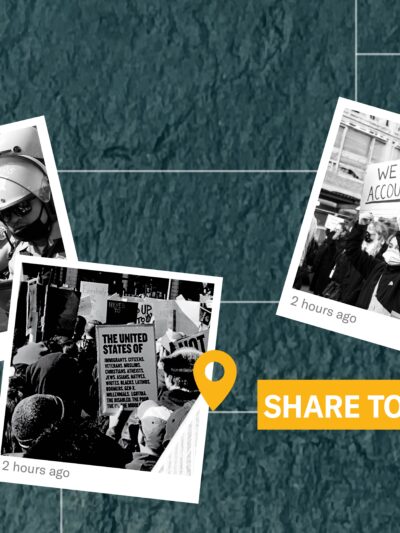
Protest and Surveillance during the DNC
The threats to our civil liberties have only become greater as surveillance technology has expanded to meet law enforcement demands.
Feb 12, 2024
Amazon Drops Neighborhood Surveillance Program
Ring, an Amazon owned company, announced it would stop allowing police departments to request Ring doorbell camera footage from users.
May 31, 2021
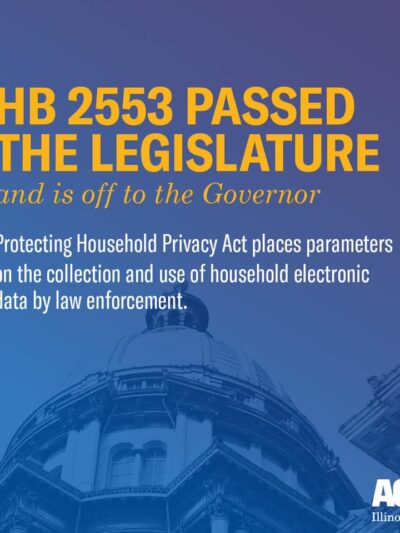
ACLU Praises Illinois Legislature For Approving House Bill 2553 – Protecting Household Privacy Act
The following statement can be attributed to Khadine Bennett, Director of Advocacy and Intergovermental Affairs, ACLU of Illinois: “Both chambers have now approved House Bill 2553, the Protecting Household Privacy Act, which now goes to the Governor for enactment. The bill provides modest guidelines on how law enforcement can access intimate data collected by household electronic devices like virtual assistants, Ring doorbells and smart appliances. As these devices grown in popularity, it is critical to protect the range of data collected by these devices. This measure is consistent with efforts in Illinois over the past several years to strike a critical balance between emerging technologies each of us use for our personal convenience and the personal data about residents in our state captured by these devices. We are grateful to Senator Cristina Castro and Representative Ann Williams for their leadership and vision, not only on this measure but on their commitment to protect privacy for all Illinois residents. We urge the Governor to sign this bill as soon as possible.”
Mar 16, 2021
Sun-Times Editorial: "Don’t gut Illinois law that prohibits the secret sale of our fingerprints and other biometric information."
Don’t gut Illinois law that prohibits the secret sale of our fingerprints and other biometric informationUnder the guise of helping small businesses, lawmakers are trying to repeal or eviscerate Illinois’ pioneering Biometric Information Protection Act.

Mar 08, 2021
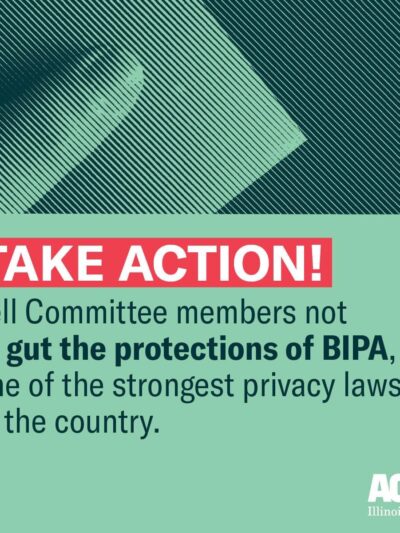
ACLU Warns that Illinois Privacy Rights at Risk this Week
Two bills threatening to weaken the nation’s strongest biometric information privacy law will get a hearing on Tuesday in the Illinois House Judiciary – Civil Committee. The proposals, House Bill 559 and House Bill 560, effectively gut the meaning and enforcement of the Biometric Information Privacy Act (BIPA), adopted unanimously by both legislative chambers a little more than a decade ago. The effort to reverse the law comes after court decisions in recent years that have held large companies like Six Flags and Facebook accountable for collecting and using the biometric information of Illinois residents.
Feb 11, 2021
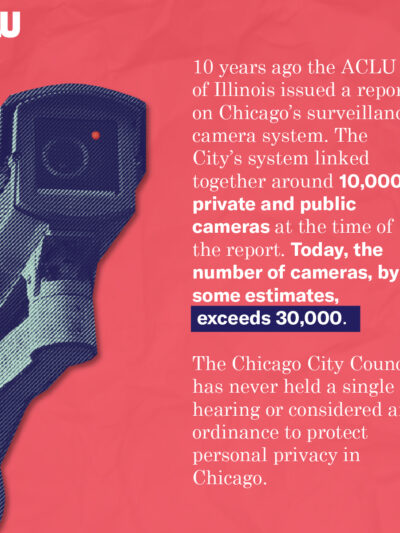
Ten Years After First Warning, Chicago’s Massive Surveillance Camera System Continues to Pose an Unregulated Threat to Privacy
The City of Chicago’s far-reaching surveillance camera system continues to expand and remains largely opaque 10 years after the release of a report first expressing alarm about cameras in the City. In February 2011, the ACLU of Illinois first issued Chicago’s Video Surveillance Cameras: A Pervasive and Unregulated Threat to Our Privacy. At the time of the report, the City’s surveillance camera system linked together around 10,000 private and public cameras. Today, the number of cameras in the system exceeds, by some estimates, more than 30,000.
Dec 09, 2020
Understanding the Methods Used and Privacy Concerns of Contact Tracing
Contact Tracing works backwards from someone testing positive for COVID-19 to identify anyone they may have come in contact with, possibly exposing them to the disease.

Nov 10, 2020
Big Brother Won’t Keep Us Safe – and Neither will Amazon Ring
Tools like Amazon Ring’s doorbell system are often touted as a solution to safety concerns. But the reality hiding behind this seemingly simple tool reveals a much darker, deeper, and growing network that uses our privacy as currency.
Jun 25, 2020
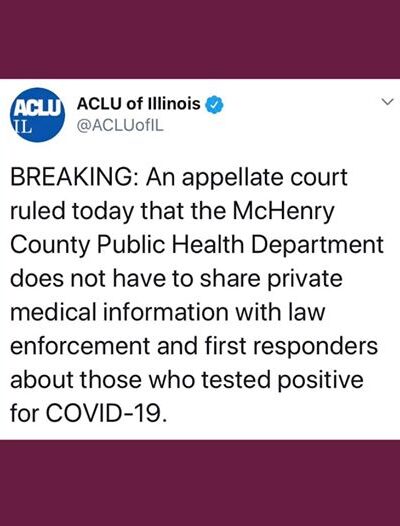
ACLU of Illinois and LULAC Respond to Court Order Stopping McHenry County from Sharing Private Medical Information
Earlier today, a unanimous panel of the Illinois Appellate Court for the Second District lifted an order mandating the McHenry County Public Health Department to share information about residents of the County who test positive for COVID-19 with law enforcement and other first responders. The ACLU of Illinois recently filed an amicus brief in this matter on behalf of the League of United Latin American Citizens of Illinois (LULAC), the Illinois Coalition for Immigrant and Refugee Rights (ICIRR) and the Health and Medicine Policy Research Group (HMPRG). The ACLU of Illinois and LULAC issued the following statements in response to the ruling: Ameri Klafeta, Women’s and Reproductive Rights Project Director, ACLU of Illinois:“The appellate court’s action today stops a violation of privacy and advances public health. Public health officials have been clear that stigmatizing people by including them on law enforcement and other first responder lists discourages testing and treatment. The ruling paves the way for everyone in McHenry County to be tested and seek treatment for COVID-19. This is our pathway out of the pandemic.” Maggie Rivera, Illinois State Director, LULAC:“This will be met as a great relief by undocumented families and families with mixed immigration status – with U.S. citizens, legal residents and undocumented individuals all under the same roof – in McHenry County. Many of these people already live in fear a loved one being swept up in an immigration raid. They should not fear seeking medical care.”
Stay Informed
Sign up to be the first to hear about how to take action.
By completing this form, I agree to receive occasional emails per the terms of the ACLU’s privacy statement.
By completing this form, I agree to receive occasional emails per the terms of the ACLU’s privacy statement.