News & Commentary
Jun 18, 2020
Groups Encourage Court to Block Sharing of Private Medical Information with Law Enforcement in McHenry County
The League of United Latin American Citizens of Illinois (LULAC), the Illinois Coalition for Immigrant and Refugee Rights (ICIRR) and the Health and Medicine Policy Research Group (HMPRG) today asked an Illinois appellate court to block the forced sharing of private medical information about McHenry County residents who have tested positive for COVID-19 with law enforcement and other first responders. The groups’ brief comes after a Circuit Court judge earlier sided with the law enforcement agencies to require sharing of this private medical information and denied a request by the McHenry County Health Department to reconsider that ruling. LULAC, ICIRR and Health and Medicine Policy Research Group oppose the release of this personal medical information as a violation of their members’ rights to keep their health information private, and as ultimately harmful – not helpful - to the health interests that some claim to be the reason for sharing the data. The amicus brief filed late yesterday argues specifically that the release of names or addresses of people who test positive for COVID-19 undermines the basic precepts of public health, and has a dangerous and stigmatizing impact on members of vulnerable communities, discouraging many in McHenry County from seeking testing and treatment in the midst of the pandemic. The three groups are being represented in this action by the ACLU of Illinois. The brief notes that if names of those who have tested positive for COVID-19 will end up in the hands of law enforcement and other first responders, many community residents will avoid seeking health care, including testing for COVID. The fact is that some will eschew testing and treatment if private medical information is shared, undermining public health efforts designed to protect all residents of McHenry County. “Undocumented families and families with mixed immigration status – with U.S. citizens, legal residents and undocumented individuals all under the same roof – already live in fear a loved one being swept up by the Trump Administration and fast-tracked for deportation,” added Maggie Rivera of LULAC Illinois and a McHenry County resident. “This is exacerbated by the self-defeating efforts of McHenry police officers who want to create an ineffective list for misguided purposes. We hope the appeals court will block this practice before it creates real harm.” Public health officials oppose the sharing of this information as well – the Illinois Department of Public Health urges that first responders treat every member of the public as potentially infectious given that many people are most contagious in the days before they suspect they may have the virus and can be tested. Moreover, Centers for Disease Control and Prevention guidelines advise first responder dispatchers to pose questions to those seeking EMS services to assess specific risks associated with responding to that call. Public health experts also note that protecting the confidentiality of medical information is essential to ensuring that people access needed medical care for appropriate diagnosis and treatment. “Sharing personal medical information for those infected with the virus with law enforcement stands in stark contrast to good public health policy and effective public health practice” says Ameri Klafeta of the ACLU of Illinois. “The pathway out of this pandemic is not through shortcuts and simple solutions. We should respect the personal medical privacy of our neighbors and continue our support for policies that will encourage people to get tested and to help us stem the spread of the disease.” “Many of our members come from countries and backgrounds where being on a government list is an invitation for stigmatization and discrimination,” added Fred Tsao, policy director at ICIRR. “Being in the United States was supposed to be the end of this sort of behavior, not a continuation. A global pandemic should be a time to put aside this self-defeating idea and seek the public health. Law enforcement in McHenry County needs to hear that message.” “Best practice in public health demands that first responders assume all people they are called to attend to may be COVID positive,” added Margie Schaps, executive director of the Health & Medicine Policy Research Group. “To provide personal medical information only on those who test positive could lull the responders into false complacency about everyone else. This puts the health of the first responders at risk as it unnecessarily invades people’s medical privacy.”

Jun 16, 2020
Clearview AI and threat to Personal Privacy
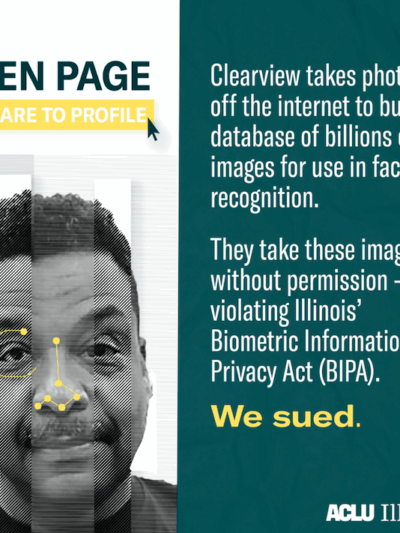
Clearview AI directly threatens the personal privacy of nearly every resident in the State of Illinois – and that is why the ACLU of Illinois joined a lawsuit to challenge their illegal practices. Since it was founded, Clearview has captured more than three billion – yes, billion – faceprints from images available on the internet. They have built this massive database with these faceprints, for profit.
Jun 07, 2020
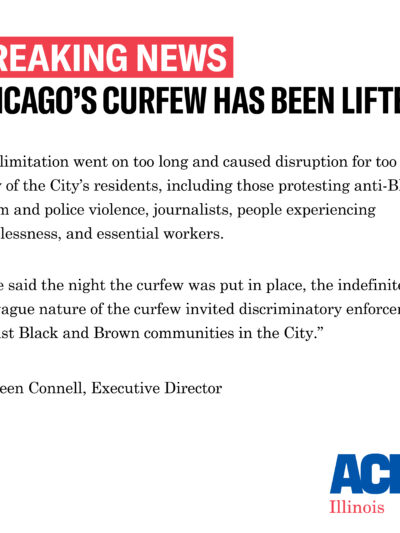
ACLU of Illinois Responds to the End of Chicago’s Curfew
The below statement can be attributed to Colleen Connell, Executive Director, ACLU of Illinois:
Jun 05, 2020
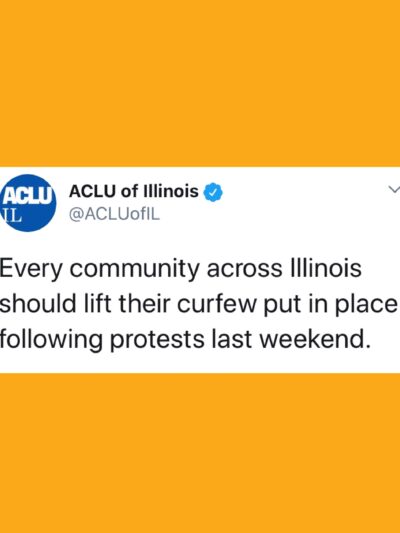
ACLU Calls for the End of Curfews Across Illinois
“This weekend, thousands of people across Illinois once again will gather together to protest anti-Black racism and the police killing of George Floyd and countless other Black people. These inspiring protests have taken place throughout Illinois, including small towns like Anna in Southern Illinois to the City of Chicago and its suburbs.
May 30, 2020
ACLU of Illinois Responds to Indefinite Chicago Curfew
The following can be attributed to Colleen Connell, Executive Director, American Civil Liberties Union of Illinois: “The Mayor’s summary announcement of a potentially indefinite curfew tonight for the entire City – with hundreds of people trapped in the Loop – raises serious constitutional questions that need to be remedied. Any curfew must be limited to the specific places in the City where there is imminent threat of danger or harm, not the entire City. The broad and vague nature of this order – and the suggestion that it is indefinite in time – invites arbitrary and discriminatory enforcement. We encourage the Mayor to rethink this strategy immediately. The ACLU of Illinois is exploring all options including litigation.”
May 28, 2020
ACLU Sues Clearview AI
The American Civil Liberties Union and the ACLU of Illinois took Clearview AI to court today to bring an end to the company’s unlawful, privacy-destroying surveillance activities. The lawsuit is the first to force any face recognition surveillance company to answer directly to groups representing survivors of domestic violence and sexual assault, undocumented immigrants, and other vulnerable communities uniquely harmed by face recognition surveillance. You can read the complaint in full here.
May 26, 2020
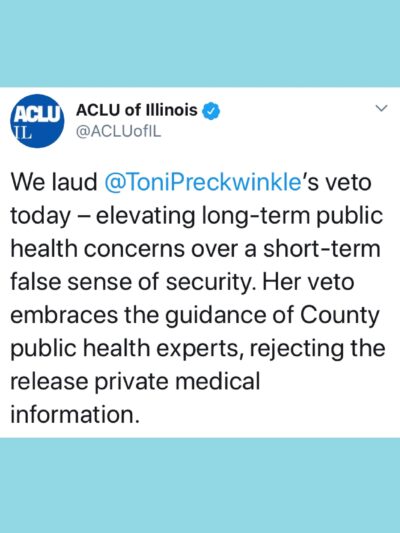
ACLU Applauds President Preckwinkle’s Veto of Cook County Board Resolution Forcing the Release of Private Medical Information
The below statement can be attributed to Colleen Connell, Executive Director, ACLU of Illinois:
May 21, 2020
ACLU of Illinois Opposes Cook County Board Resolution Forcing the Release of Private and Confidential Medical Information
In response to a proposed Cook County Board resolution compelling the disclosure of private health information to law enforcement and other first responders against the recommendation of public health experts, the ACLU of Illinois submitted testimony today strongly opposed to the measure. In testimony to the Commissioners, Executive Director Colleen Connell warned the board that sharing private medical information – the identities of all people in Cook County who have tested positive for COVID-19 – would undermine public health, increase the risk of spreading the virus, and violate federal and state legal protections.
May 15, 2020
Local Hispanic Group Seeks to Protect Personal Medical Information from Law Enforcement in McHenry County During COVID-19 Crisis
LULAC of Illinois, part of the largest and oldest Hispanic civil rights organization in the United States, wants to represent the voice of its members from McHenry County in a lawsuit that will determine whether private medical information about residents will be shared by the County public health department with law enforcement. LULAC told the Circuit Court of McHenry County in a filing earlier this week that the release of names and addresses of people who test positive for COVID-19 will undermine the basic precepts of public health, and have a dangerous and stigmatizing impact on members of the Hispanic community, discouraging many in McHenry County from seeking testing and treatment in the midst of the pandemic.

Stay Informed
Sign up to be the first to hear about how to take action.
By completing this form, I agree to receive occasional emails per the terms of the ACLU’s privacy statement.
By completing this form, I agree to receive occasional emails per the terms of the ACLU’s privacy statement.