
News & Commentary
Apr 22, 2014
The Republic: Study: Illinois law requiring kids to face adult charges for certain crimes may discriminate
Illinois laws which mandate young offenders be charged as adults, if arrested for serious crimes, cause tremendous injustice and result in racial discrimination according to a recent study by the nonpartisan Juvenile Justice Initiative. (The ACLU of Illinois is a member of the Juvenile Justice Initiative Coalition.) The study underscores the need to revamp the state’s 32 year-old laws which limit judicial discretion and which, according to the study, perpetuate, rather than curb, life-long criminal activity by the young offenders caught in the law’s web of injustice. The new study verifies the ACLU of Illinois position that trying youth in adult court has significant negative effects on public safety. The study maintains that defendants who leave juvenile court for adult court lose their best opportunity at rehabilitation, often end in prison with adults and are more likely to be caught in a cycle of recidivism. Of the 257 cases ( from 2010-2012) reviewed in the study, 83 of the defendants who were sent to adult court were black, 16 percent were Hispanic; only one defendant was a non-minority. The most perturbing finding of the study showed that 54 percent of the juveniles were ultimately sentenced for a lesser crime than the one for which they were arrested; a crime infraction that would not have sent them to adult court in the first place. The General Assembly is considering legislation introduced by State Representative Elaine Nekritz to rescind the automatic transfer laws:
Apr 15, 2014
Examiner.com: Cassidy bill proposes decriminalization for pot possession in Illinois
Illinois may follow the path of sixteen other states and revise its out-of-date, discriminatory laws against marijuana, Examiner.com writes. State Representative Kelly Cassidy (D-Chicago) introduced legislation, now under consideration in the Illinois House, to address the incredibly high expenditures required to enforce current anti-marijuana laws in Illinois. These laws also are enforced disproportionately on people of color, especially young men of color. Though pot-use percentages are similar across all social and racial demographics, studies show that in Chicago, since August 2012 when the city lowered possession penalties, 78 percent of those arrested for possessing small amounts, were black. This cost the Chicago Police Department in 2013 over $23 million, and 46,000 police man-power hours. Cassidy’s bill, which is supported by the ACLU of Illinois, approaches the problem with a solid understanding of all sides of the drug-use issue, from law enforcement safety needs as well as the long term impact of possession records. The bill focuses on less criminality, not on decriminalization, and it would expunge possession records. Ed Yohnka, ACLU of Illinois Director of Communications and Public Policy, maintains that Cassidy’s bill would avoid the:

Mar 18, 2014
Associated Press: Illinois offers plan to fix youth detention issues
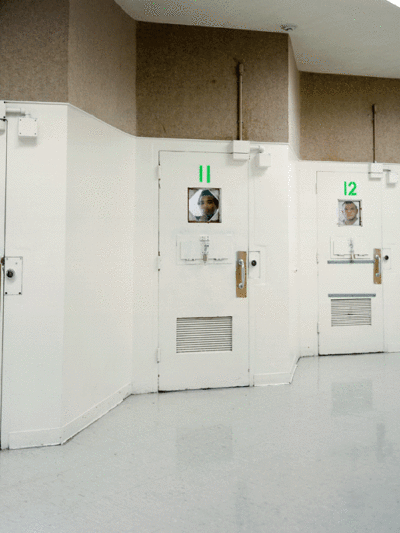
The Associated Press has an article about the remedial plan to improve conditions in six juvenile justice facilities in Illinois. The plan, released yesterday, comes as a result of a joint settlement reached by the ACLU of Illinois and the Illinois Department of Juvenile Justice. The ACLU of Illinois filed a lawsuit in 2012 on behalf of detained youth to address substandard conditions in the facilities. The remedial plan outlines five areas of improvement including education, mental health treatment, idleness, solitary confinement, community placement, and resources for LGBT youth. The Associated Press spoke with the ACLU of Illinois' Adam Schwartz about the issue of inadequate staffing:
Mar 17, 2014
The Chicago Tribune: Pact calls for better conditions for imprisoned juveniles
The Chicago Tribune published an article about a plan that outlines areas of improvement to address substandard conditions within juvenile justice facilities throughout Illinois. The proposed remedial plan, released today and filed in a district court late last week, defines five problem areas within six facilities across the state. Those areas include education, mental health treatment, idleness, solitary confinement, community placement, and rights of LGBT youth who are detained. The plan comes as a result of a settlement between the Illinois Department of Juvenile Justice and detained youth represented by the ACLU of Illinois.
Mar 17, 2014
Chicago Daily Law Bulletin: Search starts for new youth facility head
A search to select a new superintendent for the Juvenile Temporary Detention Center (JTDC) will begin soon, The Chicago Daily Law Bulletin reports. After an ACLU lawsuit claiming substandard conditions and lack of services for youth detained in the facility, the county entered into an agreement in 2002 to monitor its improvement. Earl Dunlap was hired in 2007 to oversee the facility, but now as a result of a change in state law, Cook County Chief Circuit Judge Timothy C. Evans is tasked with finding his replacement.

Feb 27, 2014
NPR: Solitary Confinement Costs $78K Per Inmate And Should Be Curbed, Critics Say
The destructive impact, at exorbitant fiscal and social costs, of prison solitary confinement was the focus of recent Senate Subcommittee hearings chaired by Senate Richard Durbin (D-IL.). Since 2010, when the Senate Subcommittee on the Constitution, Civil Rights and Human Rights first held hearings which exposed the emotional toll of prison solitary confinement, Senator Durbin has called for strict limits on its use by prison authorities. At this week’s hearings he firmly reiterated that solitary confinement is "a human rights issue we can't ignore." On “All Things Considered,” NPR Justice Correspondent Carrie Johnson highlights the key issues raised during expert testimony before the committee and notes that:

Feb 04, 2014
Chicago Sun Times: The Right Remedy For Harsh Drug Sentences
The ACLU has long maintained that any and all mandated, uniform prison sentences derail the fair and balanced application of justice. The travesty of rigidly imposed harsh, life sentences on non-violent drug offenders led to the Fair Sentencing Act of 2010 which freed judges from having to impose the one-size-fits-all sentences regardless of any mitigating circumstances, even for first time offenders. The Chicago Sun Times editorial points out that the 2010 law did not retroactively address the plight of 8,800 drug offenders already in federal prisons serving life sentences and applauds Senator Dick Durbin’s efforts to enact new, corrective legislation. The editorial quotes Deputy Attorney General James Cole who last week maintained:

Jan 29, 2014
It's Like You're Sold a Dream
I lost my drive after my older brother Rufus was sentenced. I didn't care. I didn't trust. That was my attitude. Rufus was the father figure I looked up to. When he went to jail for the rest of his life, I started looking up to his buddies. A lot of them are dead or in jail now.

Jan 14, 2014
Another endorsement for the ACLU's report on marijuana law enforcement
Nationally-renowned Washington Post columnist E.J. Dionne decries the inequitable application of anti-marijuana laws and argues for decriminalizing the drug. Citing the ACLU’s 2013 report “The War on Marijuana in Black and White,” the column dismisses the premise that there are moral and social benefits to keeping marijuana an illegal drug. Dionne says the ACLU report should be the key document used in the now occurring legalization debates and he points to the ACLU findings that, though marijuana is used at about the same rates across racial lines, Blacks are arrested for procession 3.73 times more often than Whites.

Stay Informed
Sign up to be the first to hear about how to take action.
By completing this form, I agree to receive occasional emails per the terms of the ACLU’s privacy statement.
By completing this form, I agree to receive occasional emails per the terms of the ACLU’s privacy statement.