News & Commentary
Apr 03, 2014
Peoria Journal-Star: Peoria child abuse awareness march will go off on Saturday as planned
The ACLU of Illinois helped to clarify an issue regarding a local woman's First Amendment right to peacefully assemble in a letter to the City of Peoria this week. Shelby Cooper, organizer of the city's first Million March Against Child Abuse was told that she would need to pay for a permit, and would need proof of insurance coverage for her event. She contacted the ACLU who stated in the letter:

Apr 02, 2014
Electronic Intifada: ACLU condemns Illinois senate resolution on academic boycott
The Illinois Senate Judiciary Committee debated and defeated a resolution, opposed by the ACLU of Illinois, which urged academia to condemn college and university boycotts as a tool to influence policy issues on the international scene. The defeated non-binding resolution called on Illinois college and university presidents to publicly oppose boycotts in an effort to deter any action against Israeli institutions now being promoted on many campuses by pro-Palestinian groups. Introduced by Illinois State Senator Ira Silverstein (D-8th) the resolution sited the disruptive effects boycotts have on students’ rights to a global education. ACLU of Illinois Legislative Director Mary Dixon sited the U. S. Supreme Court decisions upholding the importance of freedom of association. In her statement on the resolution Dixon said:

Apr 01, 2014
WTTW: Religious Freedom vs. Contraception Coverage
ACLU of Illinois Executive Director Colleen K. Connell appeared on WTTW's Chicago Tonight to discuss the cases of two companies - Hobby Lobby and Conestoga Wood Specialties - that are seeking exemption from the Affordable Care Act's requirement to provide access to contraception in their employee health care coverage based on religious objections. Watch the segment below:

Mar 28, 2014
Fairfield Citizen: Racial profiling prevention bill passes Ill. House
The Illinois House passed legislation to make permanent the very successful Illinois Traffic Stop Data Collection Act which requires state and local police in Illinois to record particular information (including the race of the motorist) for every civilian stopped for a traffic infraction. The measure, first adopted in 2003, under the leadership of then State Senator Barack Obama, contained a "sunset" provision resulting in several temporary extensions. Should the permanent extension also win State Senate support, police and law enforcement officials will continue to compile and report the race of every motorist stopped for traffic violations in Illinois, casting a spotlight on racial profiling problems. By making the program permanent, the bill, sponsored by Monique Davis (D-Chicago) and supported by ACLU of Illinois, keeps in place a process which forces law enforcement officials to self-assess and check their motivations for stopping drivers. Ed Yohnka, ACLU of Illinois Communications Director, emphasized that the program’s existing sunset provision would have ended the data gathering in 2015 unless another extension was granted, as has been done in the past:

Mar 28, 2014
Chicago Sun Times: Hobby Lobby tries to craft religious rights
Chicago Sun-Times columnist Neil Steinberg distills the religious freedom hyperbole surrounding the Hobby Lobby case, now before the U. S. Supreme Court, and synthesizes what the case is really about: a woman’s civil liberties. Hobby Lobby seeks exemption from the Affordable Care Act which mandates employee- health insurance policies cover contraceptives; it maintains that forcing it to comply would violate the religious beliefs of Hobby Lobby owners and share-holders. In a WTTW interview, Colleen Connell, Executive Director of the ACLU of Illinois, argued that religious freedom issues are not applicable “in this instance” because the company is a profit making corporate entity, not a religious organization. Steinberg’s Sun Times column outlines the country’s historical social progress which, over time, has mitigated the power of employers to control the private lives of their workers and pairs that reality against Hobby Lobby’s oral arguments before the court. Switching religious labels Steinberg surmised:
Mar 24, 2014
WTTW: IL Supreme Court Strikes Down Eavesdropping Law
Legal Director Harvey Grossman appeared on WTTW's Chicago Tonight to discuss the Illinois Supreme Court ruling that struck down the Illinois Eavesdropping Law. You can watch the segment below:

Mar 24, 2014
Chicago Tribune: Illinois eavesdropping law struck down as unconstitutional
On Thursday, an Illinois Supreme Court ruling in People v. Melongo struck down the decades-old eavesdropping law, ruling it as unconstitutional. The law prohibited any citizen from making an audio recording of a conversation deemed as private without getting prior consent from all parties involved with a violation resulting in a felony charge. The ACLU of Illinois had criticized the law as a violation of the First Amendment. In 2010, the ACLU of Illinois challenged the eavesdropping law as it applied to the audio recording of police officers, in the lawsuit ACLU v. Alvarez. The Chicago Tribune writes:
Mar 18, 2014
Associated Press: Illinois offers plan to fix youth detention issues
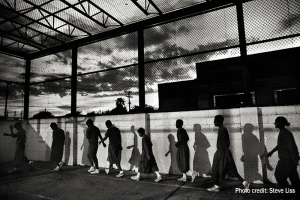
The Associated Press has an article about the remedial plan to improve conditions in six juvenile justice facilities in Illinois. The plan, released yesterday, comes as a result of a joint settlement reached by the ACLU of Illinois and the Illinois Department of Juvenile Justice. The ACLU of Illinois filed a lawsuit in 2012 on behalf of detained youth to address substandard conditions in the facilities. The remedial plan outlines five areas of improvement including education, mental health treatment, idleness, solitary confinement, community placement, and resources for LGBT youth. The Associated Press spoke with the ACLU of Illinois' Adam Schwartz about the issue of inadequate staffing:
Mar 17, 2014
Chicago Daily Law Bulletin: Search starts for new youth facility head
A search to select a new superintendent for the Juvenile Temporary Detention Center (JTDC) will begin soon, The Chicago Daily Law Bulletin reports. After an ACLU lawsuit claiming substandard conditions and lack of services for youth detained in the facility, the county entered into an agreement in 2002 to monitor its improvement. Earl Dunlap was hired in 2007 to oversee the facility, but now as a result of a change in state law, Cook County Chief Circuit Judge Timothy C. Evans is tasked with finding his replacement.

Stay Informed
Sign up to be the first to hear about how to take action.
By completing this form, I agree to receive occasional emails per the terms of the ACLU’s privacy statement.
By completing this form, I agree to receive occasional emails per the terms of the ACLU’s privacy statement.