
News & Commentary
Dec 01, 2017
Broken: The Illinois Criminal Justice System and How to Rebuild It
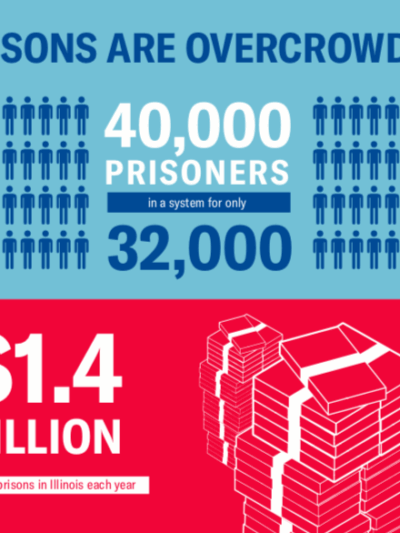
Overcrowding in Illinois prisons is up, with more than 40,000 prisoners in a system built for only 32,000. While Illinois spends more than $1.4 billion on prisons each and every year, nearly half of formerly incarcerated people return to prison within three years. The reasons why are clear: overreliance on punitive sentencing, underinvestment in education and employment opportunities in communities, and cutting or underfunding programs proven to reduce recidivism.
Aug 25, 2016
Illinois Achieved Important Bipartisan Criminal Justice Reforms. But Those Reforms Represent Only A Fraction of What Must Be Done.
Earlier this week, Illinois’ Republican Gov. Bruce Rauner and leaders from the Democratic-controlled legislature took a break from campaigning and gathered together at a ceremony in Chicago to smile for cameras and extol the spirit of compromise as the governor signed legislation aimed at reforming the state’s broken criminal justice system.
Aug 08, 2016
2016 Summer Legislative Session Recap
It was another busy summer in Springfield this session. With the budget impasse looming, our legislative efforts at times felt insurmountable. Luckily, to the benefit of our great state and all of its residents, we were able to advance critical measures that set new precedents for civil liberties and human rights in Illinois. Here is a brief roundup of some of the bills we worked on, and the progress we made:

Feb 01, 2016
A Real ‘Effect’ in Chicago Would Be Better Policing
There’s no evidence that oversight of police causes violent crime to increase

Nov 19, 2015
Statement on Hearing in FOIA Case seeking release of video showing death of Laquan McDonald
This afternoon, a Cook County Circuit Court will hear argument in a case seeking the release of video recorded by a Chicago police dashboard camera, video that shows the shooting death of Chicago teen Laquan McDonald. The video has been the subject of wide discussion and speculation, including vivid descriptions of the video’s contents in the media. The American Civil Liberties Union of Illinois today issued the following statement regarding this matter.
Nov 10, 2015
Chicago Tribune Letter to the Editor: Keeping our communities and children safe
This letter to the editor appeared in the Chicago Tribune on Tuesday, November 10.
Aug 13, 2015
ACLU Statement on Agreement with the Chicago Police Department on Stop and Frisk Reform
When the ACLU issued our report on stop and frisk in Chicago in March 2015, we made a number of explicit recommendations, all of which are recognized as “best practices” by persons who oppose unlawful stop and frisk, including: data collection about every stop by police, the public release of this data, the issuance of a receipt to every person stopped, and enhanced training of CPD officers in stop and frisk. We have advocated for these steps from the City for more than a decade. That report was widely distributed and shared with many groups who understood and shared our goals.

Aug 11, 2015
WBEZ: The myth of the low-level offender
ACLU of Illinois Criminal Justice Policy Attorney Benjamin Ruddell was quoted on a segment of the Morning Shift on WBEZ during a discussion about releasing low-level offenders from prison as a way to reduce overincarceration rates. Ruddell states that in order to effectively reduce the prison population, Illinois would need to consider ways to reduce sentences for more serious offenders:
Jun 08, 2015
Truthout: For Advocates, Push to End Solitary Confinement in Prison Only Begins With Youth Isolation
In a news analysis piece for Truthout, journalist Victoria Law profiles a young man, DeAngelo Cortijo, who was detained in a California juvenile prison beginning at age 11. The article describes Cortijo's horrifying experience of being detained in solitary confinement for seven and a half months straight when he was 17 years old. As California and other states continue the fight to limit solitary confinement for youth like Cortijo, prison reform advocates across the nation are referencing the ACLU of Illinois lawsuit, RJ v. Jones, that brought about the end of solitary confinement for youth detained in Illinois Department of Juvenile Justice facilities. The new policies reached through a settlement agreement in the case prohibit the use of solitary confinement as a means of punishment, and require youth who are in solitary confinement for 24 hours or more to spend eight hours per day out of their cell. Law spoke with ACLU of Illinois senior staff counsel Adam Schwartz, who was the lead attorney in the case, about the conditions in Illinois' juvenile justice facilities at the time the case was filed:
Stay Informed
Sign up to be the first to hear about how to take action.
By completing this form, I agree to receive occasional emails per the terms of the ACLU’s privacy statement.
By completing this form, I agree to receive occasional emails per the terms of the ACLU’s privacy statement.