
News & Commentary
May 13, 2020
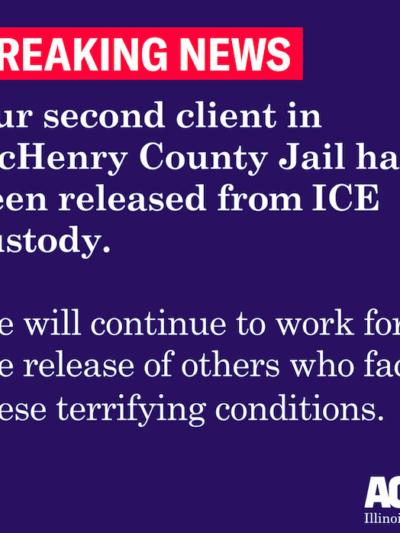
Another Medically Vulnerable Immigrant Ordered Released from ICE Custody at McHenry County Jail
Today, another man was released from ICE custody following a Monday ruling by U.S District Court Judge Rebecca Pallmeyer that he was likely to succeed in showing that conditions in the McHenry County Jail placed him at risk of severe illness and death from COVID-19. The detainee is represented by the ACLU of Illinois, the American Civil Liberties Union, and Faegre Drinker Biddle and Reath LLP in litigation in federal district court in Chicago. The lawsuit, Dembele v. Prim, was filed on behalf of two detainees of U.S. Immigration and Customs Enforcement (“ICE”) who suffer from medical conditions recognized to heighten the risk of severe complications and death from COVID-19. It sought release of these individuals because crowded and unsanitary conditions in the McHenry County Jail failed to protect them from the disease and to enable them to protect themselves in violation of due process. The other man in the lawsuit was released in April, days after the suit was filed. Reacting to the news of the release, Nusrat Jahan Choudhury, legal director for the ACLU of Illinois, issued the following statement: “We are pleased the federal court recognized that our client was likely to succeed in showing that conditions in the McHenry County Jail placed him at risk of severe illness and death from COVID-19. Both of the people we represented in this lawsuit have been released. But detention facilities remain vectors of coronavirus, and many other medically vulnerable people remain in Illinois’ ICE facilities fearing they will be the next victim of COVID. We will continue to work for the release of others who face these terrifying conditions.”
Apr 22, 2020
It’s Time for Illinois to Take the Next Step on Harsh Drug Possession Laws
This week, the ACLU released a new update to a 2013 report on the cost of cannabis enforcement across the United States, both in terms of costs and the impact on individual lives. Unsurprisingly, the report shows that the war on cannabis rages on: nationally, law enforcement made more than 6.1 million cannabis-related arrests from 2010 to 2018 - more arrests than for all violent crimes combined. These arrests eat up an enormous amount of resources from law enforcement and the criminal legal system and fall most heavily on people of color.
Apr 20, 2020
New ACLU Report Shows Black Illinois Residents Were Seven Times More Likely to be Arrested for Cannabis Before Legalization
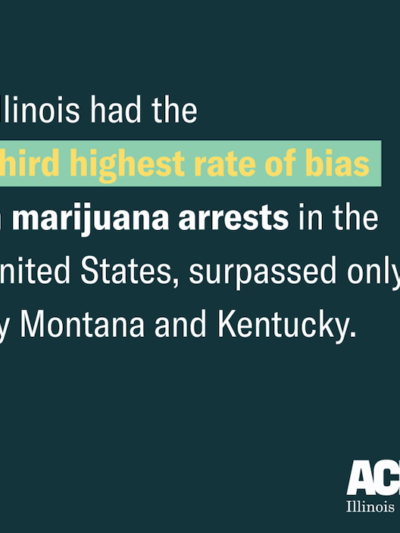
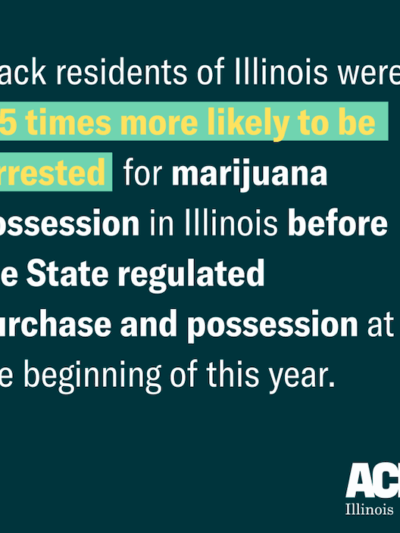
Black residents of Illinois were seven times more likely to be arrested for cannabis possession in Illinois before the State regulated purchase and possession at the beginning of this year. In fact, Illinois had the third highest rate of bias in cannabis arrests in the United States, surpassed only by Montana and Kentucky. The ACLU of Illinois noted these figures today in calling for continued vigilance to assure that remaining enforcement of cannabis in Illinois not carry on this legacy of discrimination.
Apr 16, 2020
ACLU of Illinois Reacts to State Representative Releasing Names of Commuted Prisoners
Yesterday, a state representative released the names of prisoners in Illinois granted commutation recently as part of an ongoing effort to reduce the population of Illinois prisons, which are experiencing outbreaks of the virus which causes COVID-19.

Jan 03, 2020
Ending Illinois’ Drug War: Legalizing Cannabis is Just the Beginning
Illinois took a historic step in 2019 when Governor Pritzker signed legislation to legalize the sale and possession of cannabis for recreational use by people at least 21 years of age. The new law has rightfully received praise for its focus on equity, including expungement of criminal records for cannabis offenses and earmarking 25% of revenue from cannabis sales for communities experiencing disproportionate rates of violence and concentrated disinvestment. Some champions of the new law have spoken movingly of their desire to “repair the harm” of the “failed war on drugs.”
Jul 30, 2019
Illinois Needs Strong Leadership on Sentencing Reform
For criminal justice advocates, recent headlines have provided encouragement: while the number of people incarcerated in Illinois prisons peaked in 2013 at nearly 50,000, the population has been on a steady decline since then and recently fell below 40,000—a 20% reduction.
Apr 15, 2019
Illinois, Quit Suspending Driver’s Licenses for Unpaid Parking Tickets
This op-ed originally appeared in the Chicago Sun-Times.
Aug 15, 2018
Illinois Has a New Civil Asset Forfeiture Law. But Will It Stop 'Policing For Profit?'
For years, law enforcement agencies have extracted millions of dollars in cash, vehicles, and other property from Illinois residents through the little-understood practice of civil asset forfeiture. Civil asset forfeiture laws allow the government to permanently take property away from someone on the basis that the property is associated with a crime—even though the person may never have been convicted or even arrested for any offense.

Mar 15, 2018
Undue Driver's License Suspensions are Ruining Lives. Support SB 2411 - The License to Work Act.
Driving a car is a privilege. It makes sense that the government should have the authority to set qualifications for who can operate a motor vehicle and to suspend or revoke the licenses of unsafe drivers. But while driving may not be a right, for many people in Illinois it is a necessity to live and provide for their families. More than 80% of Illinoisans drive to work, and a valid driver's license is a prerequisite just to apply for many jobs, whether or not the job involves driving.
Stay Informed
Sign up to be the first to hear about how to take action.
By completing this form, I agree to receive occasional emails per the terms of the ACLU’s privacy statement.
By completing this form, I agree to receive occasional emails per the terms of the ACLU’s privacy statement.