
News & Commentary
Oct 22, 2020
DCFS System for Providing Health Care to Children and Families Continues to Struggle to Ensure Timely, Necessary Care
Illinois is not meeting its promise to ensure children and families who receive health care through a new managed care system are receiving the medical, psychiatric, and other health care they need in a timely fashion, according to testimony offered to an Illinois Senate committee today. The Senate Human Services Committee hosted a hearing today to update members on the experience of DCFS youth and families are faring with transition to a managed health care system known as YouthCare. In testimony offered by the ACLU of Illinois, which has represented children in the care of DCFS through the B.H. litigation for nearly twenty years, the organization noted that while problems with access to health care for DCFS wards did not begin with the transition to YouthCare, the managed care system has not solved longstanding problems. “Many of Illinois’ foster children simply are not receiving the care that they need at the time when they need it,” Heidi Dalenberg, Director of the Institutional Reform Project, ACLU of Illinois. “That was true before the rollout of the YouthCare plan. It remains true today.” The ACLU pointed out that some flaws in the YouthCare system and network is creating real harm for children in DCFS care. Ms. Dalenberg related the story of one teen taken to a local emergency room in the midst of a mental health crisis, in true distress. Although all the medical professionals at the hospital agreed that the teen needed to be admitted to a psychiatric hospital, DCFS and YouthCare could not find a hospital for the teen to enter. After ten days, waiting in the emergency room, the youth was determined to be ready to be released – but never was provided the necessary psychiatric care. “It would be sad if this were the only instance of this harm to a teen,” added Dalenberg. “It is not. We know that in the month of September alone, at least ten other foster children who experienced similar circumstances– being stuck at an emergency room because a placement was not found for them. YouthCare needs to address this today.” The ACLU also shared results of a project it conducted in recent weeks to test the experience of families with finding care under YouthCare by calling physician offices in Belleville, Peoria and suburban Harvey. The ACLU tests revealed that a family calling a provider’s office for the first time would be able to secure an appointment for a child to see a physician in just 3 out of 10 calls during that first call. Among other reasons that appointments were not available:

Oct 21, 2020
It’s Time for Real Sentencing Reform in Illinois
The story of mass incarceration in Illinois is a familiar one. Our state’s experience has mirrored the national trend of skyrocketing incarceration rates which took flight in the 1970’s and peaked fewer than 10 years ago, driven by punitive policies enacted in legislatures and fueled by “tough on crime” political rhetoric.
Oct 16, 2020
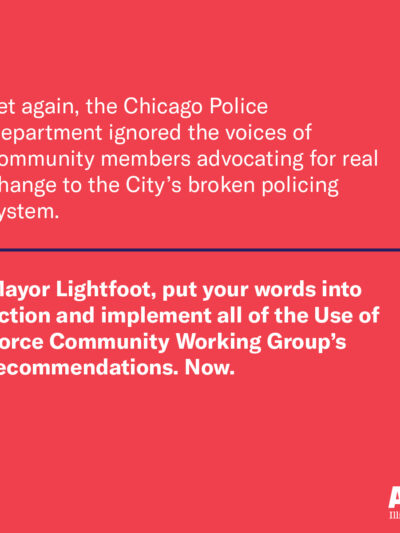
ACLU of Illinois Responds to CPD’s Rejection of Use of Force Community Working Group Recommendations
The below statement can be attributed to Rachel Murphy, Police Practices Project Staff Attorney, ACLU of Illinois:
Oct 13, 2020
The Supreme Court to Decide Whether Chicago Can Keep Cars Locked Up When Debtors File for Bankruptcy
Sandra Botello, an unemployed mother living in Chicago, faced a difficult financial choice – pay $400 in school fees for her son or cover the cost of renewing Chicago’s mandatory vehicle sticker. She paid the school fees, keeping her son’s education moving forward – but within weeks received five $200 tickets for not having a vehicle sticker. Late fees and collection fees caused her debt to balloon to nearly $3000. Chicago impounded Ms. Botello’s car for unpaid tickets, charged additional fees for storing her car for 33 days, ultimately sold the car for scrap, and left her with thousands of dollars of debt.
By Nusrat Jahan Choudhury
Oct 09, 2020
ACLU of Illinois Responds to Gov. Pritzker’s Proposals to Reform the Criminal Legal System
The below statement can be attributed to Khadine Bennett, Director of Advocacy and Intergovernmental Affairs, ACLU of Illinois:
Sep 30, 2020
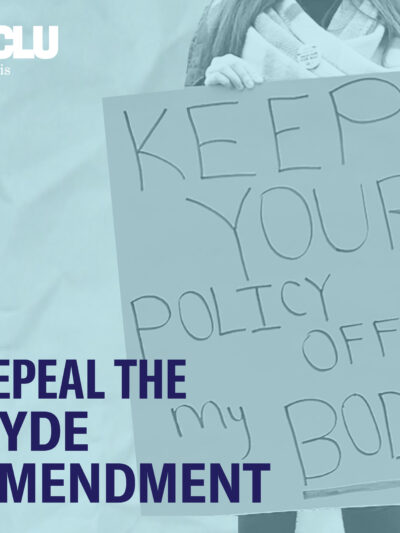
It’s Well Past Time to Repeal the Hyde Amendment
The country is closely watching the Supreme Court, wondering what Justice Ruth Bader Ginsburg’s death means for the future of Roe v. Wade and the right to access abortion care. It is important to remember, however, that many people already live in, for all practical purposes, what is a post-Roe world. Depending on where someone lives in the country, their ability to access abortion care may be legal, but limited by real-world obstacles like their ability to pay for care.
Sep 24, 2020
ACLU of Illinois Applauds IL Supreme Court Decision for Parents Under the IL Civil Union Act
Earlier today, the Illinois Supreme Court unanimously ruled in favor of Kris Fulkerson, a woman seeking to exercise her rights as a step-parent under Illinois Civil Union Act. Ms. Fulkerson entered into a civil union with the father of the child, and acted as a step-parent to the child prior to the father’s death. An appellate court denied Ms. Fulkerson the ability to seek rights as a step-parent because she and her partner had entered into a civil union, rather than a marriage. Today’s decision reverses that decision.
Sep 23, 2020
Health Care in Illinois Prisons Continues to Fail Even During Pandemic According to Court-Appointed Expert
A court-appointed medical expert charged with overseeing improvements in the health care system inside Illinois prisons again reported serious flaws in the system, including the continued need for qualified medical professionals and an effective program to control infectious diseases. The findings are contained in a comprehensive report to a federal district court in Chicago in Lippert v. Jeffreys, a case challenging the availability of adequate health care in Illinois prisons. The report, authored by Dr. John Raba, is the second accounting for the State’s progress under an agreement reached in 2019.
Sep 11, 2020
Transgender Prisoner in Federal Custody Asks Court to Order Adequate Health Care and Ensure Her Safety
Cristina Nichole Iglesias has been denied critical medical care, raped, physically and sexually abused, and even held hostage during her time housed in federal corrections facilities for men. Ms. Iglesias’ victimization is a direct result of the federal Bureau of Prisons’ (BOP) refusal to recognize Ms. Iglesias as the woman she is and to provide her the health care and the security that she desperately needs. A copy of the complaint filed today can be found here.
Stay Informed
Sign up to be the first to hear about how to take action.
By completing this form, I agree to receive occasional emails per the terms of the ACLU’s privacy statement.
By completing this form, I agree to receive occasional emails per the terms of the ACLU’s privacy statement.