News & Commentary
Nov 24, 2020
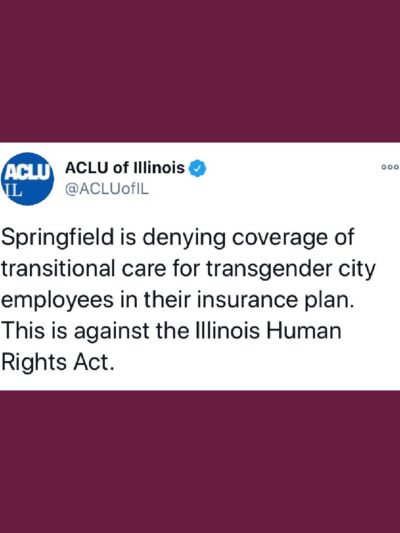
Springfield Woman Files Charge Challenging City’s Anti-Transgender Employee Insurance Plan
Kate Holt, a Springfield woman, filed a complaint last week charging that the state’s capitol is violating state law by denying insurance coverage for physician-directed care for employees who are transgender. The charge recounts how Ms. Holt was denied coverage for medication prescribed by her physician - medication covered for other employees who are not transgender - after she was employed by the City of Springfield beginning in February 2020. The denial is a clear violation of Illinois’ Human Rights Act, according to the charge.
Nov 20, 2020
To Keep People Out of its Overcrowded Prisons, Illinois Must Reclassify Its Drug and Property Crimes
Illinois still sends too many people to prison - and gives too many people felony records that follow them for life - for crimes that are often just the symptoms of poverty, addiction, and mental illness. Like a young woman in Chicago, who had her dreams of a career in medicine dashed after pleading guilty to simple drug possession. Or a teenager facing the prospect of prison after being caught stealing a winter coat from a Target store.

Nov 10, 2020
Big Brother Won’t Keep Us Safe – and Neither will Amazon Ring
Tools like Amazon Ring’s doorbell system are often touted as a solution to safety concerns. But the reality hiding behind this seemingly simple tool reveals a much darker, deeper, and growing network that uses our privacy as currency.
Nov 02, 2020
ACLU of Illinois Responds to Election Night ‘Security Plans’
The ACLU of Illinois today responded to the City of Chicago’s announcement of a security plan for Election night and beyond. The following can be attributed to Colleen K. Connell, Executive Director of the ACLU of Illinois: “This election season has been extraordinary – marked by millions of Americans waiting for hours to vote early and millions of others voting by mail. Still other Americans have encouraged those waiting to cast their ballot with advocacy, music, dancing and even cookies and pizza. In this difficult time, the American people have come together to fight the pandemic, challenge blatant voter suppression and make their voices heard. These voices will not fall silent on Tuesday. In the wake of the election, millions Americans will continue to exercise free expression – including some who will gather together in the streets of Chicago. Some will celebrate the election’s outcome; others will communicate their disappointment; and still others will want to articulate their vision of policies that make our neighborhoods and our country better. No matter the message, these are voices of Americans who have a yearning and a right to come together and be heard. The City of Chicago recently announced plans for these gatherings after the election. Above all else, any such plan must be based on welcoming all voices on to Chicago’s iconic streets and plazas to share their messages — not on silencing dissent through curfew, restrictions of transportation to and from protests, or policing that harms people. This requirement that government respect the rights of Americans to assemble and speak is embedded in our Constitution, and it is the process for improving our country. Let’s count every vote and then celebrate freedom to assemble and to speak!”
Oct 31, 2020
Reflecting on Five Years of the Next Generation Society
When the ACLU of Illinois founded the Next Generation Society in 2015, our goal was to bring together a diverse group of people united by a common commitment: to support the essential work of the ACLU. For a century, the ACLU has fought tirelessly to hold America to its promises. And over the last five years, the Next Generation Society has played a critical role in that fight. We have grown into a vibrant and vital part of the ACLU’s efforts to protect protestors’ First Amendment rights, reimagine policing, uphold reproductive freedom, preserve privacy, and much more. Activism and engagement have been central to Next Gen’s identity and impact from the start. Next Gen members have organized and participated in ACLU fundraising and events, taken to the streets, championed legislative initiatives, and served as cooperating attorneys and volunteers. When the Trump Administration issued the Muslim ban, Next Gen members showed up at O’Hare Airport to protest.
By Emmalee Scott
Oct 29, 2020
ACLU of Illinois Responds to Lack of Body Cam Footage in Waukegan Police Shooting
The statement below can be attributed to Karen Sheley, Police Practices Project Director, ACLU of Illinois:
Oct 29, 2020
ACLU of Illinois Shares How Voters Can Ensure Their Ballot is Counted Ahead Of and On Election Day
With early voting under way in the 2020 election – and a record number of mail-in ballots being distributed and returned across the State of Illinois – voters need access to more information about how they can assure their vote is recorded in November. As Election Day nears, voters also need more information about how they can change their minds, and vote in person even if they have requested a mail-in ballot.
Oct 26, 2020
Illinois Must Ensure Children in DCFS Receive the Health Care They Need
Oral Testimony of Heidi Dalenberg, B.H. v. Walker Class CounselBefore the Senate Human Services Committee Subject Matter: DCFS Youth Transition into YouthCare, October 21, 2020
Oct 22, 2020
DCFS System for Providing Health Care to Children and Families Continues to Struggle to Ensure Timely, Necessary Care
Illinois is not meeting its promise to ensure children and families who receive health care through a new managed care system are receiving the medical, psychiatric, and other health care they need in a timely fashion, according to testimony offered to an Illinois Senate committee today. The Senate Human Services Committee hosted a hearing today to update members on the experience of DCFS youth and families are faring with transition to a managed health care system known as YouthCare. In testimony offered by the ACLU of Illinois, which has represented children in the care of DCFS through the B.H. litigation for nearly twenty years, the organization noted that while problems with access to health care for DCFS wards did not begin with the transition to YouthCare, the managed care system has not solved longstanding problems. “Many of Illinois’ foster children simply are not receiving the care that they need at the time when they need it,” Heidi Dalenberg, Director of the Institutional Reform Project, ACLU of Illinois. “That was true before the rollout of the YouthCare plan. It remains true today.” The ACLU pointed out that some flaws in the YouthCare system and network is creating real harm for children in DCFS care. Ms. Dalenberg related the story of one teen taken to a local emergency room in the midst of a mental health crisis, in true distress. Although all the medical professionals at the hospital agreed that the teen needed to be admitted to a psychiatric hospital, DCFS and YouthCare could not find a hospital for the teen to enter. After ten days, waiting in the emergency room, the youth was determined to be ready to be released – but never was provided the necessary psychiatric care. “It would be sad if this were the only instance of this harm to a teen,” added Dalenberg. “It is not. We know that in the month of September alone, at least ten other foster children who experienced similar circumstances– being stuck at an emergency room because a placement was not found for them. YouthCare needs to address this today.” The ACLU also shared results of a project it conducted in recent weeks to test the experience of families with finding care under YouthCare by calling physician offices in Belleville, Peoria and suburban Harvey. The ACLU tests revealed that a family calling a provider’s office for the first time would be able to secure an appointment for a child to see a physician in just 3 out of 10 calls during that first call. Among other reasons that appointments were not available:
Stay Informed
Sign up to be the first to hear about how to take action.
By completing this form, I agree to receive occasional emails per the terms of the ACLU’s privacy statement.
By completing this form, I agree to receive occasional emails per the terms of the ACLU’s privacy statement.