
News & Commentary
Apr 15, 2014
A Real Choice for Illinois Women
Too often, a pregnant worker is forced to make an impossible decision: keep working and risk her health and pregnancy or lose her job and ability to support her family.But thanks to legislation approved by the Illinois House of Representatives last Thursday, pregnant women will soon have a real choice. Sponsored by Rep. Mary Flowers, House Bill 8 allows pregnant workers to stay on the job and support their families by requiring employers to provide reasonable accommodations to pregnant workers.Most Illinois women cann

Apr 10, 2014
Speaking out for teens
The day started with a cold downpour of rain, drenching everyone and everything, as we boarded a bus at 6:00 a.m. in Chicago to travel to Springfield, Illinois. There was no promise of sunshine for this trip, literally or figuratively, as we headed to the state capital to voice our opposition to the recently-enforced Illinois Parental Notification Act (PNA). Currently, there is not a legislative proposal before the Illinois General Assembly to rescind the law. So everyone making the trek to Springfield understood that the planned march and rally was largely symbolic. Yet, by late afternoon, as we all walked down the capitol steps, under a still misty-grey sky, everyone was smiling and there was a swagger of accomplishment as we re-boarded the buses home.Ever since a State Supreme Court ruling paved the way for enforcement of

Apr 01, 2014
WTTW: Religious Freedom vs. Contraception Coverage
ACLU of Illinois Executive Director Colleen K. Connell appeared on WTTW's Chicago Tonight to discuss the cases of two companies - Hobby Lobby and Conestoga Wood Specialties - that are seeking exemption from the Affordable Care Act's requirement to provide access to contraception in their employee health care coverage based on religious objections. Watch the segment below:

Mar 28, 2014
Chicago Sun Times: Hobby Lobby tries to craft religious rights
Chicago Sun-Times columnist Neil Steinberg distills the religious freedom hyperbole surrounding the Hobby Lobby case, now before the U. S. Supreme Court, and synthesizes what the case is really about: a woman’s civil liberties. Hobby Lobby seeks exemption from the Affordable Care Act which mandates employee- health insurance policies cover contraceptives; it maintains that forcing it to comply would violate the religious beliefs of Hobby Lobby owners and share-holders. In a WTTW interview, Colleen Connell, Executive Director of the ACLU of Illinois, argued that religious freedom issues are not applicable “in this instance” because the company is a profit making corporate entity, not a religious organization. Steinberg’s Sun Times column outlines the country’s historical social progress which, over time, has mitigated the power of employers to control the private lives of their workers and pairs that reality against Hobby Lobby’s oral arguments before the court. Switching religious labels Steinberg surmised:

Jan 21, 2014
Roe v. Wade in Illinois
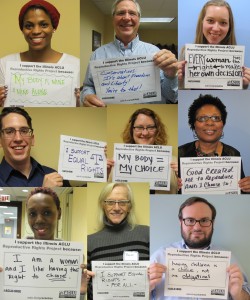
This week marks the 41st anniversary of the Supreme Court's decision in Roe v. Wade, recognizing a woman's fundamental right to determine when, and if, to become a parent – without governmental interference. Even before the Court ruled in Roe, the ACLU of Illinois' Reproductive Rights Project was fighting to assure access to a full range of reproductive health care services for women. Today, Illinois enjoys fewer restrictions than any neighboring state on abortion and other health care services for women, owing largely to the legal and legislative work directed by the ACLU of Illinois Reproductive Rights Project.
Jan 17, 2014
An Age Old Story of Control
The scene is as chilling as its setting amidst icy river-rapids: The mother of an impoverished, early 20th century, Japanese family clings to rocks immersed in the freezing water with the hope that she will abort the baby she is carrying. The blockbuster Japanese film “Oshin” is a 2013 reprise of a popular Japanese TV series and is now playing, with subtitles, on some United Airlines flights. Looking for entertainment on a long flight, the film’s spectacular winter cinematography caught my attention but the storyline kept me watching. Unable to feed their existing brood of children the father in the film considers renting out their seven-year old daughter, Oshin, as a domestic servant. The mother, wanting to keep her family intact, but with few alternatives available to women of her time and class, turns to the often harsh and brutal form of family planning practiced over centuries.The movie’s cast of strong, wise women quietly but forcefully guiding t
Jan 08, 2014
New York Times: Pregnant, and Forced to Stay on Life Support
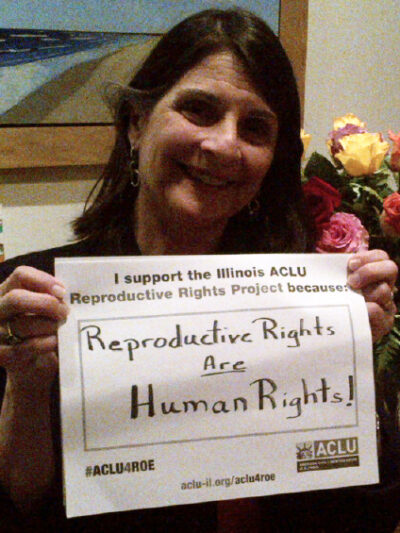
A human tragedy unfolds in Texas as a collision of patient rights, standard medical practices, and rigidly applied state laws battle over who controls death. According to The New York Times, a Fort Worth Texas hospital has over-ruled a patient’s wishes, and those of her family, refusing to disconnect the brain-dead woman from life support systems because she is 14 weeks pregnant. The hospital maintains it is doing so in compliance with Texas state law. ACLU of Illinois executive director Colleen Connell recently addressed a similar issue noting:
Jan 02, 2014
2013: A harmful year for reproductive health
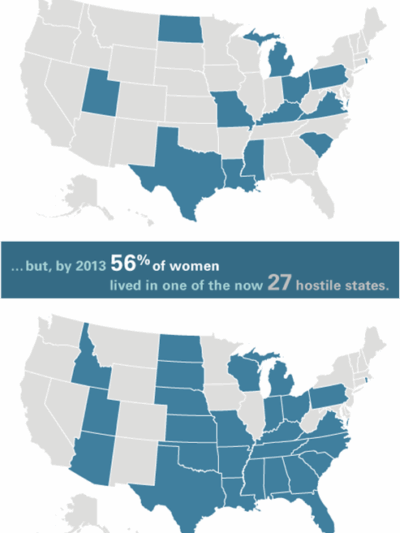
The Guttmacher Institute just released data showing a startling trend: more laws were enacted to restrict abortion in the past three years than there have been in the entire decade. The report illustrates a nationwide shift creating significant barriers to reproductive health resources even in the past year alone. Indeed, 2013 proved to be second only to 2011, as the year the highest number of abortion restrictions were created -- ever. This grim analysis, while it may not be hopeful at first glance, calls on the reproductive justice community to roll up its proverbial sleeves as we move ahead into 2014.The spike evidenced in the chart above, is a result of several factors. For one, several states didn't have legislative sessions in 2012, and also, the elections brought more anti-abortion lawmakers to the table in 2013. Perhaps the most troubling statistics gleaned from the report are the ones that show an increase in the number of states that have converted to what Guttmacher deems "hostile" to abortion rights. This category is defined by a state that has four or more types of major abortion restrictions on the books. But what this means is that a majority of women now live in states with numerous laws restricting abortion, as illustrated below:The four types of abortion restrictions referenced in the report are: abortion bans, restrictions on abortion providers, limitations on the provision of medication abortion and restrictions on coverage of abortion in private health plans. Illinois experienced a huge blow in a different realm of abortion restriction. In July, the Illinois Supreme Court upheld the Parental Notice of Abortion Act, which now requires minors seeking an abortion to have an adult family member be notified 48 hours before the procedure takes place. The ACLU of Illinois responded by creating the Illinois Judicial Bypass Coordination Project, which includes a hotline for minors seeking abortion which provides information about Illinois’ parental notice law and connects young women with a free attorney if they need one.
Dec 09, 2013
New York Times Editorial: When Bishops Direct Medical Care
The New York Times today published a powerful editorial about a lawsuit brought by the National ACLU and the ACLU of Michigan against the United States Conference of Catholic Bishops (USCCB). The ACLU represents Tamesha Means, who was denied appropriate medical care for her miscarriage at a local Catholic-sponsored hospital -- the only hospital accessible to her in Muskegon, Michigan where she resides. Means was sent home from the hospital after her water had broken at 18 weeks, despite excruciating pain and significant risk to her health, based on religious directives from the USCCB. Because of these directives, the hospital staff did not tell Means that terminating her pregnancy was an option and the safest course for her condition.
Stay Informed
Sign up to be the first to hear about how to take action.
By completing this form, I agree to receive occasional emails per the terms of the ACLU’s privacy statement.
By completing this form, I agree to receive occasional emails per the terms of the ACLU’s privacy statement.