
News & Commentary
Jan 02, 2014
2013: A harmful year for reproductive health
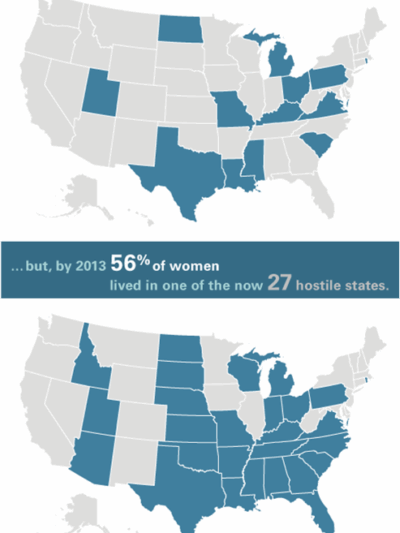
The Guttmacher Institute just released data showing a startling trend: more laws were enacted to restrict abortion in the past three years than there have been in the entire decade. The report illustrates a nationwide shift creating significant barriers to reproductive health resources even in the past year alone. Indeed, 2013 proved to be second only to 2011, as the year the highest number of abortion restrictions were created — ever. This grim analysis, while it may not be hopeful at first glance, calls on the reproductive justice community to roll up its proverbial sleeves as we move ahead into 2014.The spike evidenced in the chart above, is a result of several factors. For one, several states didn’t have legislative sessions in 2012, and also, the elections brought more anti-abortion lawmakers to the table in 2013. Perhaps the most troubling statistics gleaned from the report are the ones that show an increase in the number of states that have converted to what Guttmacher deems “hostile” to abortion rights. This category is defined by a state that has four or more types of major abortion restrictions on the books. But what this means is that a majority of women now live in states with numerous laws restricting abortion, as illustrated below:The four types of abortion restrictions referenced in the report are: abortion bans, restrictions on abortion providers, limitations on the provision of medication abortion and restrictions on coverage of abortion in private health plans. Illinois experienced a huge blow in a different realm of abortion restriction. In July, the Illinois Supreme Court upheld the Parental Notice of Abortion Act, which now requires minors seeking an abortion to have an adult family member be notified 48 hours before the procedure takes place. The ACLU of Illinois responded by creating the Illinois Judicial Bypass Coordination Project, which includes a hotline for minors seeking abortion which provides information about Illinois’ parental notice law and connects young women with a free attorney if they need one.
Dec 20, 2013
New York Times Opinion Page: End His Prosecution
The New York Times published a call from the National ACLU for the exoneration of Ed Snowden on espionage charges. The opinion piece written by Jameel Jaffer, ACLU Deputy Legal Director, reiterates all that the public has learned about N.S.A. programs and the agency’s infringement of accepted privacy standards since Snowden began releasing his information. Jaffer notes:

Dec 19, 2013
The New York Times: Obama Is Urged to Sharply Curb N.S.A. Data Mining
The New York Times writes that President Obama has received the report of a panel of experts tasked with analyzing and recommending reforms of the National Security Agency’s (NSA) intelligence gathering. The report recommends 46 changes to the agency’s current operations. The five independent intelligence and legal experts completed their report on the heels of this week’s Federal Court ruling questioning the constitutionality of the agency’s indiscriminate collection of phone-use data. The ACLU has also challenged the legality of the data gathering programs in a suit now pending in Federal Court:

Dec 18, 2013
Windy City Times: Darby vs. Orr lawsuit dismissed
The Windy City Times reports that Lazaro v. Orr has been dismissed. The ACLU Illinois and Lambda Legal, filed a motion to dismiss the twin cases that had they filed in 2012 (Lambda Legal’s Darby v. Orr and ACLU’s Lazaro v. Orr, respectively), which, on behalf of 25 same sex couples, challenged the then existing state marriage-discrimination laws. All parties agreed that passage of the Illinois marriage equality act made the suit moot. Ed Yohnka, ACLU of Illinois’ Director of Communications and Public Policy clarified the distinction between Lazaro vs. Orr and other cases filed against unequal treatment of same sex partners:

Dec 17, 2013
WBEZ: Shocking drop in services for Illinois children with severe mental illness
WBEZ investigative series on Illinois children in-need, reports that the Illinois Department of Human Services, Division of Mental Health has dramatically reduced the number of Individual Care Grants (ICG) given to families with mentally ill children. The grants were established to support families whose children need mental health care, helping to keep families together and averting mental health crises for their children. WBEZ found 11 ICG grants issued in 2013, down from 124 in 2006. WBEZ reports:
Dec 17, 2013
Washington Post: Judge: NSA’s collecting of phone records is probably unconstitutional
The Washington Post reports U.S. District Court Judge Richard Leon, citing the “almost Orwellian technology” used by the NSA, ruled that the government had failed to justify its case for the “indiscriminate” collection and retention of personal information. The ruling addressed government collection of metadata on American’s phone calls. This metadata includes the time and length of calls, as well as the numbers dialed. The Judge called the government programs a violation of privacy granted under the Fourth Amendment and granted an injunction against further NSA collection but he simultaneously stayed his order to allow for a government appeal. Seeking comments from a number of legal authorities, the Post reported reaction from the ACLU, “which has also sued the government over the program’s constitutionality:”
Dec 17, 2013
Chicago Tribune: Federal judge orders Cook County to issue wedding licenses to same-sex couples facing serious illnesses.
The Chicago Tribune reports Cook County Clerk David Orr may immediately begin to issue marriage licenses to same-sex partners combating life-threatening diseases. Couples who present the clerk’s office with physician-certified verification of their illness will not have to wait for the new marriage equality law to go into effect on June 1 of next year. The judge’s order came in response to a class action suit brought by a coalition of attorneys that included the ACLU. The Tribune writes:

Dec 16, 2013
WICS-TV: SMTD Bans Sagging Pants on Buses
The Springfield Mass Transit District (SMTD) has issued a ban on wearing “sagging pants” on its buses, local station WICS-TV reports. The ACLU of Illinois has been alerted to similar instances in the past, when a community has attempted to ban pants that hang below the waistline. The First Amendment protects individuals’ freedom of expression, and as we have sometimes seen, the attempts to ban sagging pants also have racial profiling implications.
Stay Informed
Sign up to be the first to hear about how to take action.
By completing this form, I agree to receive occasional emails per the terms of the ACLU’s privacy statement.
By completing this form, I agree to receive occasional emails per the terms of the ACLU’s privacy statement.