
News & Commentary
Jan 27, 2014
New York Times: The Expanding Power of U.S. v. Windsor
The Supreme Court’s decision last year to overturn a key provision of the Defense of Marriage Act (DOMA) in the US v. Windsor case was a milestone event for the LGBT community and a vindication of the ACLU’s position that sexual orientation should not limit equal access to participating in society. A New York Times editorial today underscores that very point in its analysis of last week’s Ninth Circuit Court decision which ruled that sexual orientation could not be used as a factor in jury selections. The Times editorial outlines how the Appellate Court decision, written by Judge Reinhardt, built on the ground breaking Windsor case and that the judge’s strongly worded opinion maintained that the precedent for equal dignity for all was tied to equal responsibilities, stating:

Jan 27, 2014
Salon: High Schools with gay-straight alliances have reduced risk of student suicide
For many years, the ACLU and other groups have promoted Gay Straight Alliances (GSA) in public schools as a means of combating bullying and discrimination against LGBTQ youth in public schools. A new study finds that these programs work. The study shows that suicide rates among high schools teenagers are lower in high schools that have a well established gay-straight alliance (GSA) group.

Jan 26, 2014
The News-Gazette: Disparity in traffic stops not limited to one city
The City of Urbana, Illinois recently created a task force in an effort to explore ways to address the ongoing racial disparity in traffic data, reported each year to the State Department of Transportation.

Jan 21, 2014
Roe v. Wade in Illinois
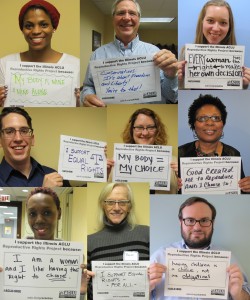
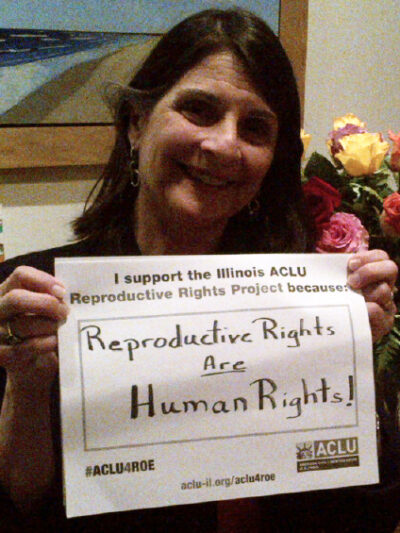
This week marks the 41st anniversary of the Supreme Court's decision in Roe v. Wade, recognizing a woman's fundamental right to determine when, and if, to become a parent – without governmental interference. Even before the Court ruled in Roe, the ACLU of Illinois' Reproductive Rights Project was fighting to assure access to a full range of reproductive health care services for women. Today, Illinois enjoys fewer restrictions than any neighboring state on abortion and other health care services for women, owing largely to the legal and legislative work directed by the ACLU of Illinois Reproductive Rights Project.
Jan 17, 2014
An Age Old Story of Control
The scene is as chilling as its setting amidst icy river-rapids: The mother of an impoverished, early 20th century, Japanese family clings to rocks immersed in the freezing water with the hope that she will abort the baby she is carrying. The blockbuster Japanese film “Oshin” is a 2013 reprise of a popular Japanese TV series and is now playing, with subtitles, on some United Airlines flights. Looking for entertainment on a long flight, the film’s spectacular winter cinematography caught my attention but the storyline kept me watching. Unable to feed their existing brood of children the father in the film considers renting out their seven-year old daughter, Oshin, as a domestic servant. The mother, wanting to keep her family intact, but with few alternatives available to women of her time and class, turns to the often harsh and brutal form of family planning practiced over centuries.The movie’s cast of strong, wise women quietly but forcefully guiding t
Jan 15, 2014
The Washington Post: Border-patrol drones being borrowed by other agencies more often than previously known
Recently released government logs document that multiple law enforcement agencies tap into the U.S. Customs and Border Protection’s extensive and sophisticated fleet of drones for domestic surveillance use, according to the Washington Post. Between 2010-2012, the Customs and Border Patrol (CBP) flew 700 drone missions for other government agencies. The logs, obtained through a Freedom of Information lawsuit, brought by the civil liberties group Electronic Frontier Foundation, reveal that the Coast Guard, the Drug Enforcement Agency and immigration authorities are using CBP drones at frequency rates higher than previously disclosed. A spokesman for the Electronic Frontier Foundation warned that the extensive drone use raised serious privacy issues. These are the same concerns raised by the ACLU of Illinois in support of the Illinois’ Freedom From Drone Surveillance Act, enacted last August to off-set possible privacy abuses by government drones. The Post reports that:

Jan 15, 2014
Chicago Tribune: Fourth Amendment is going, going...
Columnist Leonard Pitts reflects on the current disregard of the Fourth Amendment and points to the recent unsuccessful attempt to sue the U.S. Customs and Border Protection agency for unlawfully detaining a train passenger and confiscating his laptop. Pitts lists multiple areas where the Fourth Amendment is no longer enforced as a protection against warrantless government search and seizures, including the case of Pascal Abidor, who was represented by the ACLU and a number of other groups. A graduate student in Canada who holds dual U.S. and French citizenship, Abidor was pulled off a train at the Canadian border in 2010, cuffed, held for several hours and had his laptop confiscated for 11 days. Last month, Judge Edward Korman dismissed Abidor’s case, claiming that he, and his co-plaintiffs, had no standing because such searches are so rare travelers are not likely to be similarly victimized. Pitts’ list of other areas where the Fourth Amendment no longer has teeth includes:
Jan 15, 2014
The Courthouse News Service: Illinois Eavesdropping Law Assailed on Appeal
The Illinois Supreme Court heard oral arguments yesterday on the constitutionality of the Illinois Eavesdropping Act which requires consent from all parties if a conversation is recorded, whether or not the conversation is private. The ACLU of Illinois filed amicus briefs on behalf of both of the criminal defendants whose cases were heard. In People v. Clark, the accused was representing himself in a civil proceeding, and recorded a court hearing and a brief conversation with the opposing lawyer, in order to advance his access to the courts. In People v. Melongo, the defendant recorded her phone conversations with a county court reporter and then posted the recordings online, in order to advance her claim of ineffective government services. Ms. Melongo was arrested and imprisoned for 18 months while awaiting the conclusion of her trial. In both of these cases, a trial judge held that people have the right to record these kinds of conversations. The prosecutors appealed these decisions to the state’s Supreme Court. The Courthouse News highlighted portions of the ACLU of Illinois’ brief in support of Ms. Melongo’s claim.
Jan 14, 2014
Another endorsement for the ACLU's report on marijuana law enforcement
Nationally-renowned Washington Post columnist E.J. Dionne decries the inequitable application of anti-marijuana laws and argues for decriminalizing the drug. Citing the ACLU’s 2013 report “The War on Marijuana in Black and White,” the column dismisses the premise that there are moral and social benefits to keeping marijuana an illegal drug. Dionne says the ACLU report should be the key document used in the now occurring legalization debates and he points to the ACLU findings that, though marijuana is used at about the same rates across racial lines, Blacks are arrested for procession 3.73 times more often than Whites.

Stay Informed
Sign up to be the first to hear about how to take action.
By completing this form, I agree to receive occasional emails per the terms of the ACLU’s privacy statement.
By completing this form, I agree to receive occasional emails per the terms of the ACLU’s privacy statement.