
News & Commentary
Apr 22, 2014
The Republic: Study: Illinois law requiring kids to face adult charges for certain crimes may discriminate
Illinois laws which mandate young offenders be charged as adults, if arrested for serious crimes, cause tremendous injustice and result in racial discrimination according to a recent study by the nonpartisan Juvenile Justice Initiative. (The ACLU of Illinois is a member of the Juvenile Justice Initiative Coalition.) The study underscores the need to revamp the state’s 32 year-old laws which limit judicial discretion and which, according to the study, perpetuate, rather than curb, life-long criminal activity by the young offenders caught in the law’s web of injustice. The new study verifies the ACLU of Illinois position that trying youth in adult court has significant negative effects on public safety. The study maintains that defendants who leave juvenile court for adult court lose their best opportunity at rehabilitation, often end in prison with adults and are more likely to be caught in a cycle of recidivism. Of the 257 cases ( from 2010-2012) reviewed in the study, 83 of the defendants who were sent to adult court were black, 16 percent were Hispanic; only one defendant was a non-minority. The most perturbing finding of the study showed that 54 percent of the juveniles were ultimately sentenced for a lesser crime than the one for which they were arrested; a crime infraction that would not have sent them to adult court in the first place. The General Assembly is considering legislation introduced by State Representative Elaine Nekritz to rescind the automatic transfer laws:

Apr 17, 2014
Sun-Times Op Ed: Treating pregnant workers right
Writing in the Sun-Times, Cristal Thomas, deputy governor of Illinois, called on the Illinois Senate to pass House Bill 8. The bill would require employers in Illinois to provide reasonable accommodations for pregnant workers, similar to those provided for workers with temporary disabilities. The ACLU of Illinois supports the legislation, sponsored by Representative Mary Flowers, which passed out of the Illinois House on April 10th.Thomas writes:

Apr 17, 2014
exploreB2B: Illinois Considering Civil Rights for Pregnant Workers
The Illinois House of Representatives overwhelmingly passed legislation to protect the health and well-being of pregnant workers, recognizing that current state and federal laws fail to guarantee reasonable workplace accommodations for being pregnant. Sponsored by Rep. Mary Flowers and supported by the ACLU of Illinois, the bill would assure pregnant employees are granted simple, but health-protecting, accommodations that do not pose undue burdens on employers: more frequent bathroom and water breaks, the ability to have a place to sit, manual labor assistance, light duty assignments and schedule adjustments, post-partum time off, and access to a private breast-feeding area upon returning to work. None of these types of accommodations are legally available to pregnant workers under existing laws creating the need for legislative action.

Apr 16, 2014
Chicago Sun Times: Sneed: Almost 1000 gay couples have filed for Cook county marriage licenses
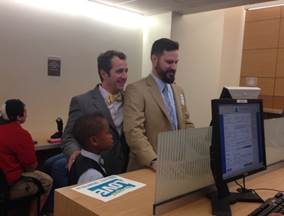
According to columnist Michael Sneed, Cook County Clerk David Orr’s office predicts that it will soon issue the 1000th marriage license to same-sex couples. In February, Federal Judge Sharon Johnson Coleman ruled for immediate marriage equality in Lee v. Orr, a suit brought by the ACLU of Illinois and Lambda Legal, and ordered the Cook County Clerk’s office to promptly begin issuing marriage license to same sex applicants. Since then the office reports processing over 950 license applications and that a third of the applicant couples traveled from other Illinois counties to Orr’s office to obtain a marriage license. The Clerk’s office anticipates reaching the 1000 milestone as soon as Friday. Courtney Greve a spokeswoman for Orr’s office stated:
Apr 15, 2014
A Real Choice for Illinois Women
Too often, a pregnant worker is forced to make an impossible decision: keep working and risk her health and pregnancy or lose her job and ability to support her family.But thanks to legislation approved by the Illinois House of Representatives last Thursday, pregnant women will soon have a real choice. Sponsored by Rep. Mary Flowers, House Bill 8 allows pregnant workers to stay on the job and support their families by requiring employers to provide reasonable accommodations to pregnant workers.Most Illinois women cann

Apr 15, 2014
Examiner.com: Cassidy bill proposes decriminalization for pot possession in Illinois
Illinois may follow the path of sixteen other states and revise its out-of-date, discriminatory laws against marijuana, Examiner.com writes. State Representative Kelly Cassidy (D-Chicago) introduced legislation, now under consideration in the Illinois House, to address the incredibly high expenditures required to enforce current anti-marijuana laws in Illinois. These laws also are enforced disproportionately on people of color, especially young men of color. Though pot-use percentages are similar across all social and racial demographics, studies show that in Chicago, since August 2012 when the city lowered possession penalties, 78 percent of those arrested for possessing small amounts, were black. This cost the Chicago Police Department in 2013 over $23 million, and 46,000 police man-power hours. Cassidy’s bill, which is supported by the ACLU of Illinois, approaches the problem with a solid understanding of all sides of the drug-use issue, from law enforcement safety needs as well as the long term impact of possession records. The bill focuses on less criminality, not on decriminalization, and it would expunge possession records. Ed Yohnka, ACLU of Illinois Director of Communications and Public Policy, maintains that Cassidy’s bill would avoid the:

Apr 10, 2014
Evanston Now: Senate approves Biss GPS privacy bill
The Illinois Senate approved the legislation limiting law enforcement agencies’ access to “real time” location tracking data generated by the electronic devices that are now used daily by an ever growing majority of Americans. The ACLU of Illinois supports the bill and points out that in 2011, phone carriers received as many as 1.3 million demands for information about their subscribers, including location-tracking information. The bill, which now goes to the Illinois House, seeks to balance privacy issues with public safety needs. It allows police and other government agencies to obtain a tracking order, similar to a search warrant, based on probable cause of a crime. In an article at Evanston Now, the bill’s sponsor, Senator Daniel Biss (D-Evanston), maintains that:

Apr 10, 2014
Speaking out for teens
The day started with a cold downpour of rain, drenching everyone and everything, as we boarded a bus at 6:00 a.m. in Chicago to travel to Springfield, Illinois. There was no promise of sunshine for this trip, literally or figuratively, as we headed to the state capital to voice our opposition to the recently-enforced Illinois Parental Notification Act (PNA). Currently, there is not a legislative proposal before the Illinois General Assembly to rescind the law. So everyone making the trek to Springfield understood that the planned march and rally was largely symbolic. Yet, by late afternoon, as we all walked down the capitol steps, under a still misty-grey sky, everyone was smiling and there was a swagger of accomplishment as we re-boarded the buses home.Ever since a State Supreme Court ruling paved the way for enforcement of

Apr 08, 2014
The Columbia Chronicle: Controversial eavesdropping law struck down
The Illinois State Supreme Court recently struck down the state's eavesdropping law. The ruling came in two cases where the law's requirement of consent of all parties before a conversation could be recorded had been used in some places to prosecute individuals who recorded conversations that were really not private, or involved recording public officials doing their public duties. The Court found the language of the law was too vague and too broad in permitting these prosecutions. Now, members of Illinois General Assembly must pass legislation in order to put an eavesdropping law in place. The ACLU of Illinois has urged the General Assembly to maintain the important privacy protections in the previous law, protections that protect residents of Illinois against broad government intrusion. Ed Yohnka, ACLU of Illinois Communications Director noted the challenge here:

Stay Informed
Sign up to be the first to hear about how to take action.
By completing this form, I agree to receive occasional emails per the terms of the ACLU’s privacy statement.
By completing this form, I agree to receive occasional emails per the terms of the ACLU’s privacy statement.