
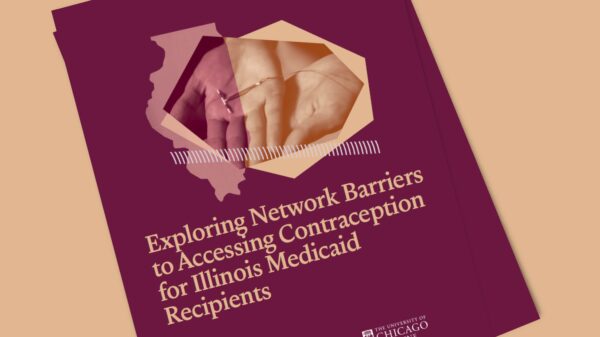
CHICAGO – According to a new report, people who receive their medical care through the Illinois Medicaid program can face myriad obstacles to timely access to the contraceptive method of their choice, despite state law requiring Illinois Medicaid to cover all FDA-approved contraceptive methods and other lawful reproductive health care. Exploring Network Barriers to Accessing Contraception for Illinois Medicaid Recipients – released today by the ACLU of Illinois, ICAN!, and researchers from the University of Chicago Department of Family Medicine – calls for the state to make some simple changes to how it administers the Illinois Medicaid program to address these challenges.
“Illinois holds itself out as a national leader in access to reproductive health care, and yet women on Medicaid in our state access contraceptive services at rates below the national average,” said Allison Siebeneck of the ACLU of Illinois. “This report shows the widespread nature of the issues that patients can face when seeking to obtain contraceptive care, and how it is impacting people across the state.”
The Illinois Medicaid program contracts with managed care organizations (MCOs) to deliver health care services to recipients through their networks of providers across the state. The report released today analyzes hundreds of patient simulation calls conducted over the course of 2025 to health care providers in the Peoria and Effingham areas attempting to use Medicaid insurance to access Paragard, a non-hormonal intrauterine device (IUD) which is one of the most effective birth control methods available. Each of the providers contacted had been identified as in-network Obstetrician/Gynecology or Family Planning providers by the state’s five main MCOs.
Only one in seven of these provider contacts resulted in a hypothetical patient being able to make an appointment to access the specific method of contraception sought within five weeks. Many of the contacts revealed that the information provided by the MCOs about in-network providers was out of date or simply inaccurate. Other calls exposed issues like excessively long wait times, providers who only accepted limited numbers of Medicaid patients, and providers who did not offer all FDA-approved contraceptives. Finally, some providers stated that they would not provide the requested contraceptive services because of their own religious objections or the objections of their health care system.
“A right to birth control on paper means nothing if Illinois Medicaid patients can’t access the care they need when they need it,” said Kai Tao, ND, MPH, CNM of ICAN!. “When care is delayed or denied, patients face untreated conditions and lose the ability to determine if, when, and under what circumstances to become pregnant. That burden falls hardest on the people who already face the greatest obstacles to accessing health care.”
“Our finding that religious restrictions impact access to contraception for Medicaid recipients isn’t surprising,” added Lee Hasselbacher, Research Associate Professor with the University of Chicago Department of Family Medicine and a contributor to the report. “We know from prior research in Illinois that patients in religious health settings – or even secular health settings that adhere to the religious restrictions of prior owners – experience limitations on the contraceptive care they can obtain, often not even realizing there’s an issue until they show up for their appointment.”
The report makes a series of recommendations for the state aimed at improving access to care, including:
- Enabling providers and facilities to identify “contraception for pregnancy prevention” as a subspecialty and requiring MCOs to include information about this subspecialty in searchable provider directories;
- Updating MCO contracts to require that members be notified of their free choice of a family planning provider in member handbooks, prohibit coercive or directive counseling about contraceptive options, and require the utilization of additional performance measures.
- Making contraceptive care quality measures publicly available for the public to analyze; and,
- Including a specific question about the scope of family planning services in “secret shopper” surveys used to assess MCO network adequacy.
You can read the full report here.
Stay Informed
Sign up to be the first to hear about how to take action.
By completing this form, I agree to receive occasional emails per the terms of the ACLU’s privacy statement.
By completing this form, I agree to receive occasional emails per the terms of the ACLU’s privacy statement.