
Settlement Reached in Case Challenging Chicago Police Deployment
November 17, 2021 9:45 am
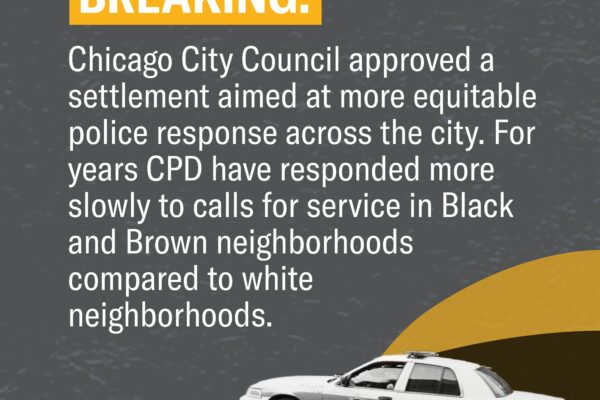
CHICAGO – An Austin-based community group has reached a settlement with the City of Chicago aimed at addressing the chronic disparity in police response times to calls from white neighborhoods compared to neighborhoods that are primarily Black and Brown. The settlement resolves a lawsuit first filed in October 2011 by the Central Austin Neighborhood Association that challenged these longstanding racial disparities. Data released due to the filing of the lawsuit revealed that neighborhoods of color often had no police to dispatch in response to a 911 call reporting a violent offense, while white neighborhoods had ample officers to respond even in non-emergency situations.
“After a decade-long journey to bring equity and fairness to police deployment, this settlement is a small but important step forward,” said Ron Reid, one of the CANA members who filed the lawsuit a decade ago with his wife Serethea. “The test will be whether CPD actually follows through, and better serves neighborhoods such as ours.”
“For us and for our neighbors, nothing really has changed about police response in Austin,” added Serethea Reid. “CPD has the technology to track when police actually respond to a call for help. They must track every call and every response – and use that data to ensure that every neighborhood gets service based on need, not race.”
Under the agreement reached in the litigation, the City promised the following improvements:
- Improving the collection of data about 911 calls, including the police response time for each call. Currently, the City says it is able to produce data for only around 60% of all calls; they pledge to use their best efforts to improve that percentage to 80% within three years;
- The publication of data about police response times (on a district-by-district basis) each month. This reporting will begin within three months of approval of the agreement; and
- The incorporation of the principle of equitable police response to calls for service into any new staffing plan developed under the federal consent decree guiding systemic reform of CPD.
The uneven deployment of police officers in Chicago – and the result that neighborhoods of color regularly experience longer delays in response to 911 calls than white neighborhoods – has been an historic issue in the City. Unfortunately, nearly every Police Superintendent has promised – but failed – to address this serious racial and public health disparity.
A decade ago, one analysis of police response times in the Town Hall area (which is predominantly white) and Chicago Lawn (with a population that is predominantly people of color) underscored the problem. Over a period covering 2009 to 2011, CPD was unable to respond to 911 calls in Town Hall on only 17 occasions. But during the same period, CPD was unable to respond to calls in Chicago Lawn on 885 occasions. The disparity is clear.
“This racial disparity in police responses to calls for service was tolerated for too many years due solely to politics,” said Colleen K. Connell, executive director of the ACLU of Illinois in response to the settlement. “The result was that too many neighborhoods like the one represented by CANA were ignored. We hope this settlement is a step in redressing this historic wrong in Chicago.”
Lawyers for the ACLU of Illinois were assisted by Eric Mattson of Sidley Austin in representing CANA in this litigation.
Stay Informed
Sign up to be the first to hear about how to take action.
By completing this form, I agree to receive occasional emails per the terms of the ACLU’s privacy statement.
By completing this form, I agree to receive occasional emails per the terms of the ACLU’s privacy statement.