
News & Commentary
Apr 15, 2021
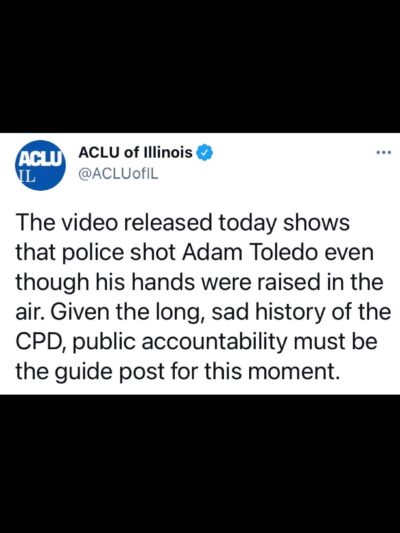
ACLU of Illinois Responds to the Release of the Adam Toledo Video
The statement below can be attributed to Colleen Connell, Executive Director, ACLU of Illinois:
Apr 14, 2021
Federal Court Asked to Protect Detainees from COVID at Chicago Metropolitan Correctional Center (MCC)
A group of four men detained at the Chicago Metropolitan Correctional Center (MCC) today asked a federal court to step in and immediately order long overdue measures to protect those detained in MCC before a third wave of COVID sweeps through the facility. The MCC has been a vector for spread of the coronavirus since last spring. In May 2020, 20 to 25% of the population was diagnosed with an infection, despite a lack of testing throughout the facility. The rate in the Fall was even higher. The request comes today in a motion filed on behalf of the four detainees and a potential class of other detainees. The group is represented by lawyers for the ACLU of Illinois and the law firm Winston & Strawn. Yet, the facility has taken few, if any steps, to address the spread of COVID. With COVID cases on the rise again in Chicago and Illinois, it is only a matter of time before another outbreak. “MCC officials have failed to adopt a coherent strategy for confronting COVID,” said Camille Bennett, Director of the Corrections Reform Project at the ACLU of Illinois. “It is time for the court to order a plan for the facility – before it is once again too late.” “A year into this pandemic, MCC residents have been left without the basic tools to combat the spread of COVID-19 that many of us take for granted—masks and the ability to social distance—not to mention access to crucial education regarding vaccines,” said Thomas Weber, Partner at Winston & Strawn LLP. The demand for a specific plan comes in a lawsuit filed in late January by two detainees and later joined by three others. The MCC, where they are held, has had between 500 and 600 persons detained there, although it is a facility designed for only 400 detainees. This overcrowding has caused double-bunking in small cells and the housing of up to 100 persons in dormitory units and facilitated the spread of COVID-19. Today’s filing notes that little is being done to facilitate vaccines in the MCC. COVID vaccines have been slow to arrive there, and detainees have received little information and no education about their safety and efficacy. Some staff have even added to hesitancy by suggesting that the vaccine might be dangerous. The Federal Bureau of Prisons, which runs the MCC, has its own problem of staff vaccination hesitancy, having reported that, nationwide, barely 50% of staff have accepted offered vaccinations. In addition, while other correctional systems have adopted widespread testing to help identify outbreaks before they gain hold, MCC, despite its two serious episodes, is still without routine testing. Sanitation and plumbing problems vex the facility, and one year into the pandemic, MCC residents still do not have reliable masks, and staff—who enter and exit every day—do not consistently comply with masking mandates. “It is a matter of when, not if, there is another outbreak at MCC,” added the ACLU’s Bennett. “We are fearful that another surge may come any day now.” “MCC residents cannot socially distance. They are at the mercy of a correctional system that has so far refused to protect them with measures—testing, masking, vaccine and vaccine education—that have been shown to work. The government must act now to avoid further needless harm.” The filing asks the court to order a number of steps:

Apr 06, 2021
Illinois’ Chance to Repeal a Harmful Abortion Law
Parental Notice of Abortion Violates Human Rights, Harms Young People

Apr 05, 2021
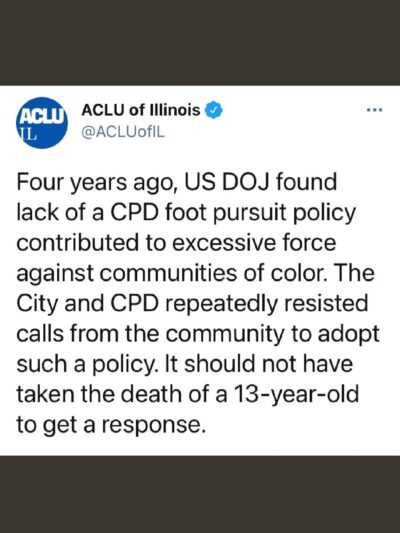
ACLU of Illinois Says Reform of Chicago Police Foot Pursuits is Long Overdue
The below statement can be attributed to Nusrat Choudhury, legal director at the ACLU of Illinois: “The death of 13-year-old Adam Toledo, shot to death by Chicago police officers, is a tragedy for the Toledo family, the community and the entire City. We grieve for his mother, family, and friends. Foot pursuits in Chicago long have been dangerous. That continues today. The Monitor overseeing the consent decree designed to reform the CPD last week demonstrated that the percentage of Chicago police foot pursuits involving deadly force more than doubled in the most recent reporting period. Four years ago, the US Department of Justice unequivocally found that CPD’s lack of a foot pursuit policy contributed to patterns of excessive force against communities of color. For four years, the City and CPD resisted repeated calls from advocates and the community to adopt a foot pursuit policy. It should not have taken the death of a 13-year-old to finally get a response. A Chicago Police Department policy on foot pursuits is long overdue and must address unsafe foot pursuit tactics and set forth guidelines that balance the objective of apprehending people for whom there is reasonable suspicion of unlawful conduct with the serious risk of injury and harm.”
Mar 31, 2021
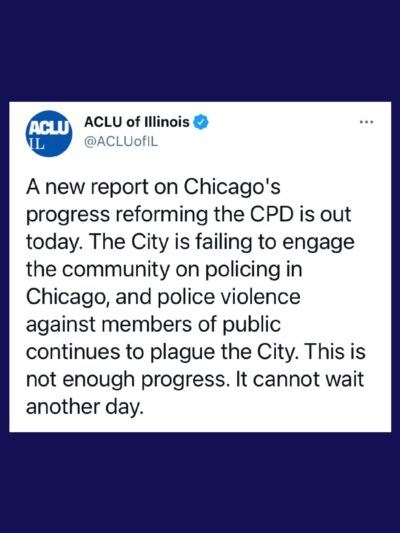
Independent Monitor’s Report Shows Chicago Police Continue to Lag in Complying with Consent Decree
The below statement can be attributed to Nusrat Choudhury, legal director at the ACLU of Illinois: “The Monitor’s report issued last night begs a simple question: What change in policing are Chicago residents actually seeing in their neighborhoods? This question urgently needs a positive answer more than two years after the entry of a federal court consent decree governing Chicago police to remedy patterns of excessive force against people of color and people with disabilities. But Black and Brown neighborhoods are seeing little, if any, change. The City has made insufficient progress in changing policing on the ground. Today’s report catalogues once again that the City and Chicago Police Department missed most deadlines—measures required under the consent decree to fix broken policing in a City with a painful history of police violence. Most strikingly, the monitor’s report shows a continued absence of real community engagement – the lynchpin of ensuring that changes to policing address communities’ needs and painstakingly rebuild the trust between police and neighborhoods that has been destroyed. The Monitor finds that the City and CPD lack consistent procedures for engaging community members and, that when they do reach out, they prevent “meaningful participation” by seeking public comment late in the process when policies are close to being finalized. This is not community engagement. The City and CPD must actually want to meet early with community members and organizations from the neighborhoods most impacted by police violence, be open to their recommendations, and collaborate on solutions. This approach has been woefully absent from the City’s response to community concerns about wrong home raids that hurt Black and Brown communities, where the City has not met with the coalition of community organizations enforcing the Chicago Police consent decree, which raised this issue months ago. The Monitor recognizes that many of those who protested in the streets of Chicago last summer following the horrific killing of George Floyd are calling for police accountability and other changes that directly relate to around twenty separate provisions of the Chicago policing consent decree. Yet, Chicago police met many protesters with baton strikes to the head, pepper spray, retaliation for recording police violence, and efforts to evade accountability by covering their name badges and star numbers. In the face of this real time police violence in the midst of calls for racial justice, missing fewer deadlines and providing documents to the Monitor is not enough. We call on the City to reflect in its conduct that the consent decree is an opportunity for working with community partners in the hard work of transformational change to advance fairness and safety for all communities. It has been four years since the U.S. Department of Justice report laid bare the problems causing the Chicago Police Department’s pattern of unconstitutional police violence against people of color. The need for action cannot wait another day.”
Mar 25, 2021
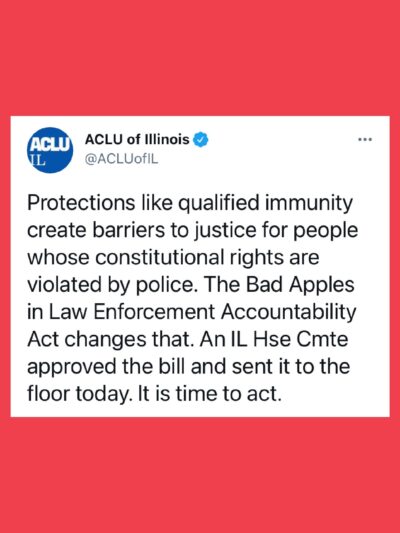
ACLU Celebrates Approval of House Bill 1727 - The Bad Apples in Law Enforcement Accountability Act - by the Illinois House Restorative Justice Committee
The following statement can be attributed to Khadine Bennett, Director of Advocacy and Intergovernmental Affairs, ACLU of Illinois:
Mar 23, 2021
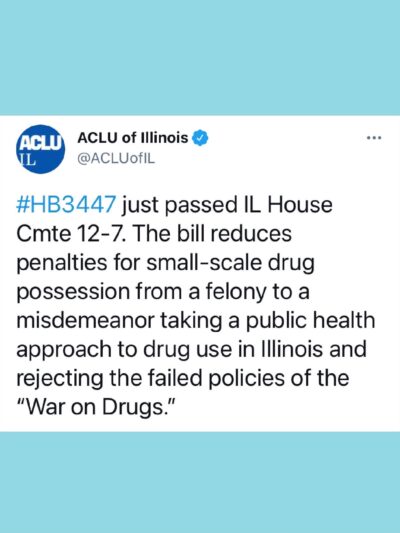
Legislation Embracing a Proven Public Health Approach to Drug Use in Illinois Moves Forward in the House
A bill that would install a public health approach to drug use in Illinois today cleared a key House Committee in Springfield. Rejecting the failed policies of the “War on Drugs,” House Bill 3447 reduces penalties for small-scale drug possession from a felony to a misdemeanor. Testimony before the Committee demonstrated the compelling need for shifting the State’s approach to drug use. The vote in favor of the bill was 12 to 7.
Mar 22, 2021
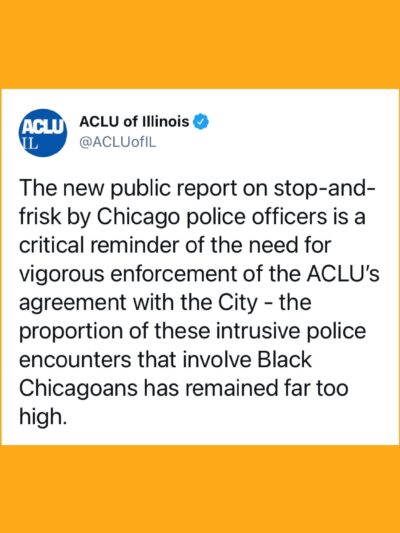
ACLU of Illinois Reacts to the Consultant’s Report on Stops and Frisks by Chicago Police
The below statement can be attributed to Nusrat Choudhury, legal director at the ACLU of Illinois:
Mar 16, 2021
Sun-Times Editorial: "Don’t gut Illinois law that prohibits the secret sale of our fingerprints and other biometric information."
Don’t gut Illinois law that prohibits the secret sale of our fingerprints and other biometric informationUnder the guise of helping small businesses, lawmakers are trying to repeal or eviscerate Illinois’ pioneering Biometric Information Protection Act.
Stay Informed
Sign up to be the first to hear about how to take action.
By completing this form, I agree to receive occasional emails per the terms of the ACLU’s privacy statement.
By completing this form, I agree to receive occasional emails per the terms of the ACLU’s privacy statement.