
News & Commentary
Feb 04, 2014
Chicago Sun Times: The Right Remedy For Harsh Drug Sentences
The ACLU has long maintained that any and all mandated, uniform prison sentences derail the fair and balanced application of justice. The travesty of rigidly imposed harsh, life sentences on non-violent drug offenders led to the Fair Sentencing Act of 2010 which freed judges from having to impose the one-size-fits-all sentences regardless of any mitigating circumstances, even for first time offenders. The Chicago Sun Times editorial points out that the 2010 law did not retroactively address the plight of 8,800 drug offenders already in federal prisons serving life sentences and applauds Senator Dick Durbin’s efforts to enact new, corrective legislation. The editorial quotes Deputy Attorney General James Cole who last week maintained:

Jan 29, 2014
Honoring Fred Korematsu: 1/30/1919-3/30/2005
He was 23, in a San Francisco prison for defying a federal order, and had gone so far as to change his name and undergo minor plastic surgery to avoid arrest. In 1942, most would call the young man’s actions, at best, imprudent; at worst, suspicious and disloyal. Few would consider him a brave patriot. The country was at war and citizens wrapped themselves in a cloud of apprehension that measured civic duty and loyalty through obedience. Few supported the imprisoned shipyard worker, Fred Korematsu, or condoned his refusal to report, as ordered, to his assigned “Assembly Center” in Oakland where the federal government was rounding up Japanese Americans for relocation out of west coast states.Ernest Besig, then Director of the ACLU-Northern California saw Korematsu

Jan 29, 2014
The Chicago Tribune: Revenge porn ban introduced in Springfield
Illinois State Senator Michael Hastings (D-Orland Park) has introduced legislation to criminalize revenge postings of nude or sexually explicit photos and videos on the internet. Calling such posts harassment and cyber bullying, Hastings’ bill would make it a felony to post these types of pictures, taken during private relationships, on the internet without permission. Hastings maintains that current Illinois statutes fail to offer protections against former partners sharing pictures out of revenge. Similar bills are being considered in 13 other states and have already been enacted in New Jersey and California. However, the ACLU has long urged caution whenever issues of free speech and censorship are raised. In a statement commenting on Senator Hastings’ bill, Ed Yohnka, ACLU of Illinois Communications Director, maintained that:
Jan 29, 2014
It's Like You're Sold a Dream
I lost my drive after my older brother Rufus was sentenced. I didn't care. I didn't trust. That was my attitude. Rufus was the father figure I looked up to. When he went to jail for the rest of his life, I started looking up to his buddies. A lot of them are dead or in jail now.

Jan 27, 2014
New York Times: The Expanding Power of U.S. v. Windsor
The Supreme Court’s decision last year to overturn a key provision of the Defense of Marriage Act (DOMA) in the US v. Windsor case was a milestone event for the LGBT community and a vindication of the ACLU’s position that sexual orientation should not limit equal access to participating in society. A New York Times editorial today underscores that very point in its analysis of last week’s Ninth Circuit Court decision which ruled that sexual orientation could not be used as a factor in jury selections. The Times editorial outlines how the Appellate Court decision, written by Judge Reinhardt, built on the ground breaking Windsor case and that the judge’s strongly worded opinion maintained that the precedent for equal dignity for all was tied to equal responsibilities, stating:

Jan 27, 2014
Salon: High Schools with gay-straight alliances have reduced risk of student suicide
For many years, the ACLU and other groups have promoted Gay Straight Alliances (GSA) in public schools as a means of combating bullying and discrimination against LGBTQ youth in public schools. A new study finds that these programs work. The study shows that suicide rates among high schools teenagers are lower in high schools that have a well established gay-straight alliance (GSA) group.

Jan 26, 2014
The News-Gazette: Disparity in traffic stops not limited to one city
The City of Urbana, Illinois recently created a task force in an effort to explore ways to address the ongoing racial disparity in traffic data, reported each year to the State Department of Transportation.
Jan 21, 2014
Roe v. Wade in Illinois
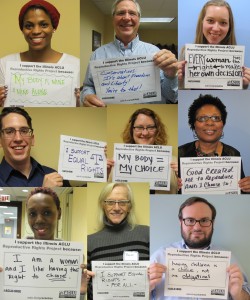
This week marks the 41st anniversary of the Supreme Court's decision in Roe v. Wade, recognizing a woman's fundamental right to determine when, and if, to become a parent – without governmental interference. Even before the Court ruled in Roe, the ACLU of Illinois' Reproductive Rights Project was fighting to assure access to a full range of reproductive health care services for women. Today, Illinois enjoys fewer restrictions than any neighboring state on abortion and other health care services for women, owing largely to the legal and legislative work directed by the ACLU of Illinois Reproductive Rights Project.
Jan 17, 2014
An Age Old Story of Control
The scene is as chilling as its setting amidst icy river-rapids: The mother of an impoverished, early 20th century, Japanese family clings to rocks immersed in the freezing water with the hope that she will abort the baby she is carrying. The blockbuster Japanese film “Oshin” is a 2013 reprise of a popular Japanese TV series and is now playing, with subtitles, on some United Airlines flights. Looking for entertainment on a long flight, the film’s spectacular winter cinematography caught my attention but the storyline kept me watching. Unable to feed their existing brood of children the father in the film considers renting out their seven-year old daughter, Oshin, as a domestic servant. The mother, wanting to keep her family intact, but with few alternatives available to women of her time and class, turns to the often harsh and brutal form of family planning practiced over centuries.The movie’s cast of strong, wise women quietly but forcefully guiding t

Stay Informed
Sign up to be the first to hear about how to take action.
By completing this form, I agree to receive occasional emails per the terms of the ACLU’s privacy statement.
By completing this form, I agree to receive occasional emails per the terms of the ACLU’s privacy statement.