
News & Commentary
Sep 02, 2020
ACLU of Illinois Testimony on Police Training and Use of Force
Illinois General Assembly Joint Hearing With Senate Criminal Law Committee and Senate Special Committee On Public SafetySubject Matter On: Police Training & Use of ForceSeptember 1, 2020
By Karen Sheley

Aug 31, 2020
Advocate Groups Respond to Chicago Police Department’s Unlawful Policing
This statement can be attributed to the signed groups below:
Aug 21, 2020
Call for an Independent Monitor Follows Testimony That IDOC Has Failed to Improve Care for Transgender Prisoners
The State of Illinois has not made the bulk of the changes to provision of medical care for transgender individuals in state prison ordered by a federal judge nine months ago. Instead, several Illinois Department of Corrections (IDOC) officials now admit that they have largely disregarded the court’s order and continue to deny transgender individuals the health care they need. This causes these individuals continued suffering, leading to harmful self-treatment efforts or even suicide attempts. Because the State has failed to act, transgender prisoners now are asking the judge who ordered the changes last year to appoint an independent monitor to oversee that IDOC finally make the necessary changes. The request comes in a filing today in the case Monroe v. Jeffreys pending in the Southern District of Illinois. Following a two-day hearing in 2019, Judge Nancy Rosenstengel ordered IDOC to overhaul its medical care for transgender prisoners. Foremost among the changes, the Judge ordered IDOC to immediately cease making medical treatment decisions by an internal committee made up of people with no relevant experience or expertise and whose members never even met with patients. In depositions this summer, IDOC officials who are members of this committee acknowledged that it still makes medical decisions relating to hormone therapy and surgery. IDOC officials also admitted that women who are transgender continue to be kept in male prisons and routinely strip-searched by male guards, despite the court’s order that they avoid these searches. “Janiah, Sora, Sasha, Marilyn, and Lydia, and the class of more than one hundred transgender individuals they represent, continue to be denied the crucial medical care they need,” said John Knight, LGBTQ Project Director at the ACLU of Illinois. “In addition, the State’s refusal to recognize these women as who they are by routinely keeping them in male prisons where they are searched by men is humiliating and causes them extreme and life-threatening suffering. The situation for transgender men is similarly concerning.” “IDOC has demonstrated that it simply cannot do this work by itself with the urgency necessary – an independent monitor is the only apparent way to protect the health and safety of our clients.” Despite representations to the court earlier this year that IDOC was ending certain practices and making progress in complying with other changes the court ordered, the statements of IDOC officials – made under oath – belie those claims. Despite telling the court that the committee was no longer making medical decisions, Dr. Melvin Hinton, the Chief of Mental Health, testified in June that the committee continues to decide when a transgender prisoner begins hormone therapy and whether a transgender prisoner should undergo gender-affirming surgery. The Court also ordered IDOC to provide prisoners with clothing and grooming items for social transition treatment. But, again, Dr. Hinton testified that IDOC and the committee continue to deny electrolysis and other forms of gender-affirming social transition. Another member of the committee – Ms. Tangenise Porter – acknowledged that she was still being asked by other committee members for her to weigh-in on medical treatment decisions for transgender prisoners, including decisions about housing, and without being given any guidance or standards for making such decisions. “Nine months have passed without meaningful change for our clients in IDOC,” added Knight. “More concerning, the State continues to assert to the court that they are making changes, despite the testimony of those charged with fixing the system. We simply cannot wait for more promises and more empty words. We need an independent monitor now.” Plaintiffs in this case are represented by the ACLU, along with lawyers from Kirkland & Ellis, King & Spalding, and Kennedy Hunt, P.C.
Aug 07, 2020
Your Immigration Status Should Not Be a Death Sentence. But in Illinois It Still Can Be.
Souleymane Dembele is a loving husband to a lawful permanent resident of the United States and father to three U.S. citizen children. Like many people in Illinois, he has pre-existing medical conditions, including hypertension that is managed with medication. Until a few months ago, however, Mr. Dembele feared for his life. That was because he was held in Immigration and Customs Enforcement (ICE) custody at McHenry County Jail as COVID-19 spread across the country and our state like wildfire.
By Nusrat Jahan Choudhury
Aug 06, 2020
ACLU of Illinois Reacts to County Sheriffs Rushing to Restart Transfer of Prisoners to IDOC During COVID-19 Pandemic
News reports in Illinois indicate that a number of county sheriffs have begun the process of transferring prisoners held in county jails to the custody of the Illinois Department of Corrections (IDOC). These transfers had been blocked by an order from Governor Pritzker as part of the State’s strategy to curb the spread of COVID-19 in state correctional facilities. After a group of county sheriffs challenged the order, a Logan County Judge ruled against the Governor’s order, and sheriffs quickly began the transfer process before the ruling could be appealed.
Aug 03, 2020
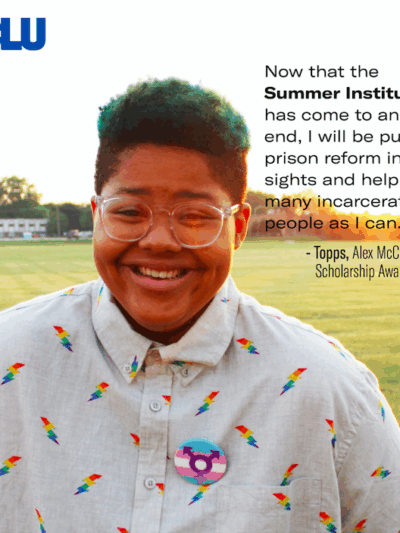
“Crisis Creates Opportunity”: My Experience at this Year’s Virtual ACLU Advocacy Institute
As I opened my computer and prepared to click on the Zoom link for this year’s ACLU National Advocacy Institute, I felt very anxious about what was to come. Automatically muting my mic and deciding on whether or not to show my face or just my profile picture, I was greeted by this amazing voice. This person was so thrilled to speak to us youth about social justice issues that have been plaguing our minds and was actually willing to listen.
Jul 31, 2020
ACLU of Illinois Reacts to Announced Overhaul of the Illinois Department of Juvenile Justice
The following statement can be attributed to Camille Bennett, Director of the Corrections Reform Project, ACLU of Illinois:
Jul 31, 2020
First Amendment Challenge of Panhandling Restrictions Moves Forward
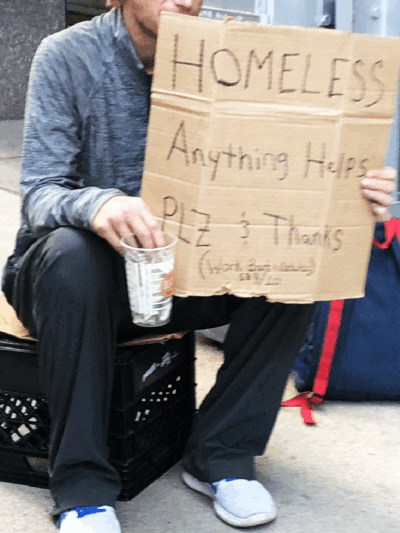
Two men repeatedly ticketed for seeking help to survive from motorists stopped at a Downers Grove intersection can continue their lawsuit against the Village and six individual police officers for violating their rights under the First Amendment, according to U.S. District Court Judge Robert W. Gettleman. The ruling came yesterday in a lawsuit filed by Michael Dumiak and Christopher Simmons in August of 2019.

Stay Informed
Sign up to be the first to hear about how to take action.
By completing this form, I agree to receive occasional emails per the terms of the ACLU’s privacy statement.
By completing this form, I agree to receive occasional emails per the terms of the ACLU’s privacy statement.