Driving a car is a privilege. It makes sense that the government should have the authority to set qualifications for who can operate a motor vehicle and to suspend or revoke the licenses of unsafe drivers. But while driving may not be a right, for many people in Illinois it is a necessity to live and provide for their families. More than 80% of Illinoisans drive to work, and a valid driver's license is a prerequisite just to apply for many jobs, whether or not the job involves driving.
Every year, tens of thousands of people in Illinois lose their driver's licenses - and in many cases, their ability to work - for reasons that have nothing whatsoever to do with unsafe driving. Increasingly, driver's license suspensions are imposed not as a punishment for moving violations but as a tool for the government to try to collect revenue from people who have fallen behind on payment of parking tickets or other fines and fees. Unsurprisingly, the impact of these heavy-handed collection tactics falls most heavily upon low-income communities and people of color.
ProPublica recently reported that in Chicago, parking and traffic tickets brought in nearly $264 million in 2016--about 7% of the city's $3.6 billion operating budget. Debt for unpaid tickets disproportionately impacts the city's lowest-income residents, and the highest rates of accumulated ticket debt per adult are concentrated overwhelmingly in majority African American communities.
The relative lack of jobs in low-income neighborhoods means that people from these communities often need to commute to other parts of the city or the suburbs in order to work. Those who live or work in "transit deserts" can be left without any viable transportation options when they lose their driving privileges.
The proliferation of ticket debt has corresponded with an explosion in driver's license suspensions: the number of suspension requests from the City of Chicago to the Secretary of State's office tripled between 2010 and 2016. These suspensions don't make the roadways any safer. Instead, they force people to choose between unemployment, bankruptcy, or risking going to jail for driving on a suspended license. License suspensions also punish families, because people need to drive in order to get their kids to school, to care for the needs of their elderly relatives, and much more.
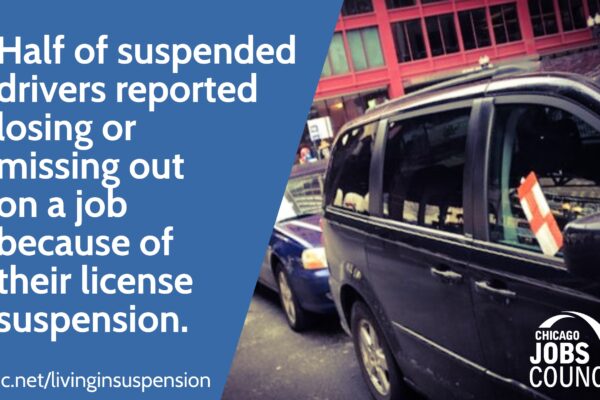
This week, the Chicago Jobs Council released their new report Living in Suspension which highlights the negative impacts these unnecessary driver's license suspensions are having on people's lives in Illinois. In CJC's survey of more than 500 respondents from across the state, they found that:
- 52% who had their licenses suspended as a result of non-driving violations missed out on an employment opportunity as a result of the suspension
- 72% of the survey respondents would need to pay more than $500 in order to re-obtain a valid license
- 31% of the survey respondents would need to pay more than $3000 in order to re-obtain a valid license
Given that 46% of adults in America say they could not cover an emergency expense costing $400, it is not surprising that so many people who owe debts for unpaid tickets opt to file bankruptcy-over 10,000 cases in Chicago alone last year according to the ProPublica article.
This is why we support SB 2411 (Previously HB 5340) that would change this counter-productive policy. The License to Work Act would eliminate driver's license suspensions as a penalty for non-payment of parking ticket debt and other violations not related to safe driving and would allow a person whose license was suspended for a non-driving violation to get it back.
It is appalling that this situation has gotten as bad as it has, with so many people's livelihoods and families being put at stake. This common-sense change in the law would help people escape the cycle of ticket debt and get back to work, to the benefit of everyone in Illinois.
For more information about the License to Work Act, please click here.